Week 04-the Bible
The Bible is the reliable and authentic inspired message of God for His Church. Let's look it's structure, history, and evidence for this claim.
40 WEEKS STUDYTEMPLATE
2/7/20214 min read
The Vegetative Stage
(building structural capacity for future fruit)
40 Weeks Study
We're assuming you've already worked through the 40 Days study and have also given each of the preceding topics it's week's worth of attention. If so, let's do some intentional preparation for future fruit bearing.
Week 4 : The Bible
Where we left off... 40 Days - Day 4:
The Bible is the reliable representation of God’s inspired message for us. It answers the most important questions facing any person.
What you should learn this week:
We have significant external evidence that supports the consistency of the Bible with the original writings.
The Bible claims to be the very words of God that reveal Himself, His Plan, and our role in it.
The Bible should be interpreted as one overarching cohesive message that should govern your life.
Your "Faith in Action" challenge this week:
Choose one of the following books of the Bible and read at least three chapters from it each and every day. When you reach the end, continue back at the beginning of the book. Aim to read it through several times this week.
Philippians - A letter from Paul and Timothy that encourages believers to rejoice in Christ, live in unity and humility, and stand firm in faith despite trials.
Ephesians - A letter from Paul that places unity and love at the center of God's eternal plan.
2 Timothy - A letter from Paul to Timothy encouraging him to remain faithful, guard the truth, and faithfully pass it on.
1 Peter - A letter from Peter that encourages believers to stand firm in faith, live holy lives amid suffering, and remain hopeful in God’s promises despite persecution.
1 John - A letter from John that teaches believers how to live in God’s love, walk in the light, and discern truth from error,.

Video1: History of the protestant Canon
Videos in this week's reading schedule...
Video2:Reliability of The Scriptures

Video3: Dead Sea Scrolls: Evidence of Preservation Over Time

Study Tool to Explore
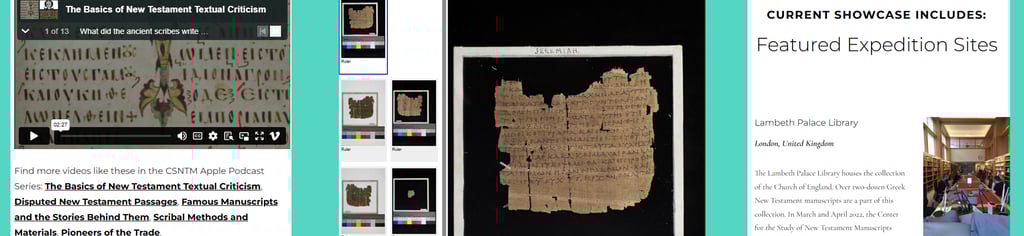
The Center for the Study of New Testament Manuscripts (CSNTM) pursues the great and noble task of preserving the New Testament text and manuscripts, and tracing its history through the ages. They have digitized dozens of manuscript collections, provide those images online, and educate laymen on this important area of work.
Manuscripts 101: Detailed educational resource introducing Textural Studies. Overview of the technical taxonomy including types of material, handwriting, and manuscript classifications.
Visit their site for academic quality books, videos, blogs, and galleries of scanned manuscripts.
Some Thoughts for Group Discussion
Show your progress on the memory verse, discuss what you learned from the Faith in Action challenge, and discuss your observations in the reading/viewing schedule.
Discuss the time-context of 2 Tim 3:16 and whether or not it makes sense to extrapolate Paul's statement to the New Testament.
Summarize significant events and timeline of Biblical canonization.
OT Timeline
1400–400 BC — OT books written (from Moses to post-exilic prophets).
~400 BC — Last OT books (Malachi, Chronicles) completed.
Before 200 BC — Jewish communities widely recognize the Torah, then the Prophets, as authoritative.
200–100 BC — The Writings gain recognition; usage varies slightly by region.
150–100 BC — Septuagint (LXX) Greek translation begins; includes translations of all Hebrew books + additional Jewish literature.
1st century AD — Jesus and the apostles treat the threefold Hebrew Scriptures (“Law, Prophets, Writings”) as established.
90 AD (Jamnia) — Jewish rabbis discuss books already accepted; not a canon-creating council, but confirms common usage.
2nd century AD — Most Jewish communities standardize around the 39-book Hebrew canon.
NT Timeline
45–95 AD — NT books written (from James and Paul to John’s writings).
100–150 AD — Early churches read apostolic writings publicly; collections (e.g., Paul’s letters) circulate.
140 AD — Marcion creates a distorted canon, prompting the church to articulate what was already in use.
170–200 AD — Muratorian Fragment lists most NT books; shows widespread agreement except for a few shorter letters.
200–300 AD — Major church fathers (Irenaeus, Tertullian, Origen) quote almost all 27 NT books as authoritative.
325 AD — Council of Nicaea mentions Scripture but does not define the canon.
367 AD — Athanasius’ Easter Letter lists the exact 27 books of the NT we have today.
393 & 397 AD — Councils of Hippo and Carthage affirm the same 27-book NT canon already functioning in churches.
Have each person summarize (in their own words) the evidence around textural reliability of the scripture.
Review Day 25: Purposed in Unity . As implied in that title, unity (oneness in the body of Christ) is at the heart of our purpose. It glorifies God in a very particular way. Discuss how His glory is reflected in the Church and visualized in Rev 21:11.
johna.gain100ad@gmail.com
Copyright © 2025 - my40Days