Week 08-Works
Grace initiates reconciliation, faith appropriates that grace to our account, and we can participate in God’s redemptive administration only as we submit and obey.
40 WEEKS STUDYTEMPLATE
2/2/2021138 min read
The Vegetative Stage
(building structural capacity for future fruit)
40 Weeks Study






We're assuming you've already worked through the 40 Days study and have also given each of the preceding topics it's week's worth of attention. If so, let's do some intentional preparation for future fruit bearing.
Week 8 : Works
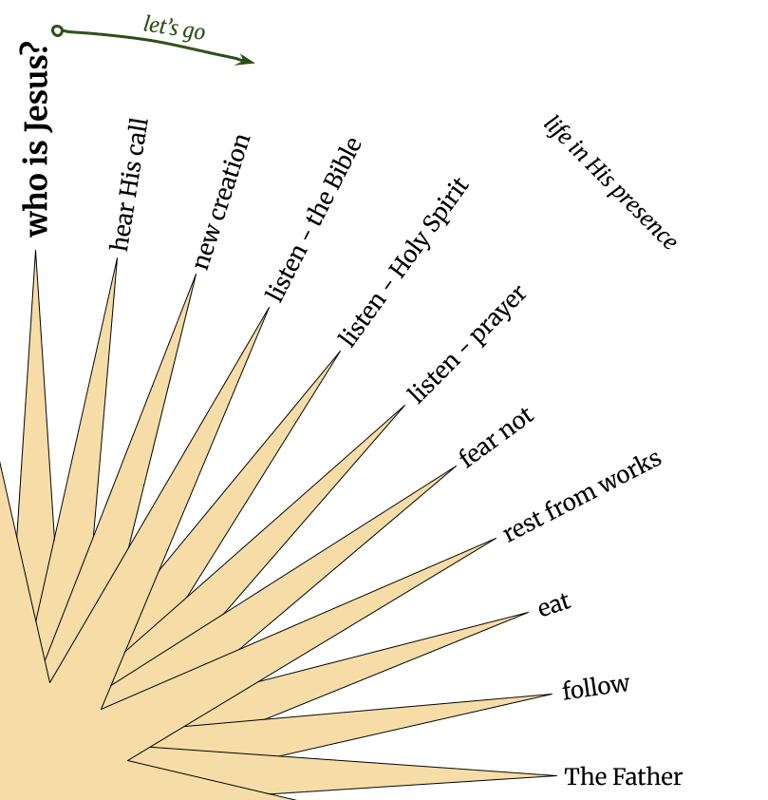

Where we left off... 40 Days - Day 8:
There is an appropriate motive for doing “good works.” But, earning forgiveness and acceptance isn't it.
What you should learn this week:
Develop a meaningful personal definition for grace.
Explain the underlying significance of our reliance on grace.
Recognize how "saving faith" is manifested in the first three commandments.
Explain the interaction between grace, faith, and Sabbath rest.
Your "Faith in Action" challenge this week:
It's important to take note and record steps in your personal "story of grace."
tbd
Still Working on This Week...
Study Tool to Explore
Blue Letter Bible - Interlinear "Parsing"
We've already introduced the Blue Letter Bible Interlinear tool. Let's talk about a feature that may prove useful. This is a screenshot of what you'd see if you opened the interlinear tool from Ephesians 2:5. Notice the "Parsing" column.


Until you learn what the abbreviations in the parsing button mean, you can click on the button and get the expansion pop-up. This screenshot shows the popup for the word "by grace." The parsing button will indicate what kind of word it is (noun, verb, adjective, participle, preposition, conjunction) and how it is functioning in the sentence.
For a noun, it will tell you the case, number, and gender. Here we've selected "charis - grace" and it shows case = dative, number = singular, gender = feminine.
For a verb, it will tell you tense, voice, mood, person, and number.
We'll learn more about each of these terms in future Greek Snapshots. Knowing all the tools and terms used here won't make you an expert translator. But, sometimes it gives you insight into what choices the translators made in generating the English text.
Parsing shows you how a word works in a sentence, not just what it means—and theology sometimes lives in that difference.
Some Thoughts for Group Discussion
Show your progress on the memory verse, discuss what you learned from the Faith in Action challenge, and discuss your observations in the reading schedule.
Remember, the Exodus narratives are recorded for us to learn from with a strong admonition to not make those same mistakes (1 Cor 10:1-22). Just as they did, we believers inherit the covenant with Abraham. But, there is a complex arc across Abraham's story that we need to think about. Abraham's story begins with God's grace initiating relationship with him. There is no doubt about that. But, was Abram's initial obedience a pre-requisite to the covenant that was later established with him? What would that mean to us today?
Ancient Hebrew does have explicit conditional particles—if, if/when, and unless—which are regularly used to establish juridical conditionality. None of these appear in Genesis 12:1–3. The passage does not say, “If you go, then I will bless you.” (By contrast, the promise is restated to Isaac in Genesis 26:3–4 does use explicit conditional particle.) However, Hebrew employs other mechanisms to convey contingency without juridical formality. Two are especially relevant here:
The imperative + imperfect result sequence (often described as a waw-imperfect result chain), and
The use of purpose/result (telic) clauses. (telic means there is an end-goal at play)
Genesis 12:1–3 employs both of these mechanisms. With these, the ratifying the Abrahamic covenant presupposes something about Abram's responsiveness.
The command לֶךְ־לְךָ (go for yourself) is a direct imperative, followed by a chain of imperfect verbs: וְאֶעֶשְׂךָ (“and I will make you”), וַאֲבָרֶכְךָ (“and I will bless you”), וַאֲגַדְּלָה (“and I will make great”). In Hebrew narrative and covenantal discourse, this structure regularly signals a command → outcome sequence, where the outcomes are contingent upon the command being enacted. If the command is not taken up, the promised chain has no narrative activation.
Additionally, the phrase “and be a blessing” functions as a purpose/result clause. It is neither an imperative nor a juridical stipulation but a volitional expression. The blessing is not mechanically inevitable; Abram must choose to participate in its outworking. Genesis 12:1–3 thus functions as a telic sequence, oriented toward a divinely intended end. If Abram does not go, that telos (end-goal) is not realized through him.
Taken together, the passage presents relational conditionality: Abram is invited to participate in what God intends to do. The promise is real, but participation requires obedient trust. God’s plan will move forward, but Abram’s role in it is contingent upon his response.
This structure contrasts clearly with:
Genesis 9:11–17, which contains no conditionality at all,
Genesis 15, where the contingency structure is removed and the covenant is unilaterally ratified because Abram is already in the promised relationship and place, and
Exodus 19:4–6, which exhibits explicit juridical conditionality.
The summary is that the relationship between Abram and God was established before the covenant could be ratified. The covenant simply elaborated the details.
In Galatians 3–4, Paul does not deny Abram’s obedience; he denies obedience as "the juridical basis of covenant standing"—a logic introduced only with the Mosaic Law. The relational conditionality in Genesis 12 is not the act of "going" in order to participate. Rather, this obedience was a reflection on an internal disposition. Genesis 15 establishes a unilateral covenant (which we can inherit) in which the covenant’s continuation rests entirely on divine faithfulness and is received by faith. But, the Abrahamic template suggests a pre-requisite state.
Genesis 15 shows that the covenant rests on God’s faithfulness, while Genesis 12 reveals the human posture required to enter it—humble trust and a heart oriented towards obedience. In both Testaments, grace is never received apart from submission, yet it is never earned by obedience.
Jesus says If you love me, you will keep my commandments (John 14:15, 1 John 3:23). If you are not inclined to obey when the Holy Spirit convicts, then you probably aren't in a covenant relationship with God.
Treatise on Good Works
Dr. Martin Luther, 1520 AD
DEDICATION
JESUS
To the Illustrious, High-born Prince and Lord, John Duke of Saxony, Landgrave of Thuringia, Margrave of Meissen, my gracious Lord and Patron.
Illustrious, High-born Prince, gracious Lord! My humble duty and my feeble prayer for your Grace always remembered!
For a long time, gracious Prince and Lord, I have wished to show my humble respect and duty toward your princely Grace, by the exhibition of some such spiritual wares as are at my disposal; but I have always considered my powers too feeble to undertake anything worthy of being offered to your princely Grace.
Since, however, my most gracious Lord Frederick, Duke of Saxony, Elector and Vicar of the Holy Roman Empire, your Grace's brother, has not despised, but graciously accepted my slight book, dedicated to his electoral Grace, and now published—though such was not my intention, I have taken courage from his gracious example and ventured to think that the princely spirit, like the princely blood, may be the same in both of you, especially in gracious kindness and good will. I have hoped that your princely Grace likewise would not despise this, my humble offering, which I have felt more need of publishing than any other of my sermons or tracts. For the greatest of all questions has been raised, the question of Good Works; in which is practised immeasurably more trickery and deception than in anything else, and in which the simpleminded man is so easily misled that our Lord Christ has commanded us to watch carefully for the sheep's clothing under which the wolves hide themselves.
Neither silver, gold, precious stones, nor any rare thing has such manifold alloys and flaws as does good works, which ought to have a single simple goodness, and without it are mere color, show and deceit.
And although I know and daily hear many people, who think slightly of my poverty, and say that I write only little pamphlets and German sermons for the unlearned laity, this shall not disturb me. I would to God that I had in all my life, with all the ability I have, helped one layman to be better! I would be satisfied, thank God, and be quite willing then to let all my little books perish.
Whether the making of many great books is an art and a benefit to the Church, I leave others to judge. But I believe that if I were minded to make great books according to their art, I could, with God's help, do it more readily perhaps than they could prepare a little discourse after my fashion. If accomplishment were as easy as persecution, Christ would long since have been cast out of heaven again, and God's throne itself overturned. Although we cannot all be writers, we all want to be critics.
I will most gladly leave to anyone else the honor of greater things, and not be at all ashamed to preach and to write in German for the unlearned laymen. Although I too have little skill in it, I believe that if we had hitherto done, and should henceforth do more of it, Christendom would have reaped no small advantage, and have been more benefited by this than by the great, deep books and quaestiones, which are used only in the schools, among the learned.
Then, too, I have never forced or begged anyone to hear me, or to read my sermons. I have freely ministered in the Church of that which God has given me and which I owe the Church. Whoever likes it not, may hear and read what others have to say. And if they are not willing to be my debtors, it matters little. For me it is enough, and even more than too much, that some laymen condescend to read what I say. Even though there were nothing else to urge me, it should be more than sufficient that I have learned that your princely Grace is pleased with such German books and is eager to receive instruction in Good Works and the Faith, with which instruction it was my duty, humbly and with all diligence to serve you.
Therefore, in dutiful humility I pray that your princely Grace may accept this offering of mine with a gracious mind, until, if God grants me time, I prepare a German exposition of the Faith in its entirety. For at this time I have wished to show how in all good works we should practice and make use of faith, and let faith be the chief work. If God permits, I will treat at another time of the Faith itself—how we are daily to pray or recite it.
I humbly commend myself herewith to your princely Grace, Your Princely Grace's Humble Chaplain,
DR. MARTIN LUTHER.
From Wittenberg, March 29th, A. D. 1520.
THE TREATISE
Luther’s Fundamental Doctrine of Good Works (Sections I - VIII)
I. Good works are defined only by God’s commandments, not by human opinion.
I. We must first know that there are no good works except those which God Himself has commanded, just as there is no sin except that which God has forbidden. Therefore, whoever wishes to know and to do good works needs nothing more than to know God’s commandments. Thus Christ says in Matthew 19, “If you would enter into life, keep the commandments.” And when the young man asks Him in Matthew 19 what he must do to inherit eternal life, Christ sets before him nothing other than the Ten Commandments. Accordingly, we must learn to distinguish good works according to the commandments of God, and not according to their outward appearance, size, or number, nor according to the judgment of men or of human law or custom—as has been done and is still done—because we are blind and despise the divine commandments.
II. God’s foundational command is to believe in Christ. All other “good works” depend on this first “work” of obedience.
II. The first and highest, the most precious of all good works is faith in Christ, as He says in John 6. When the Jews asked Him, “What must we do, that we may work the works of God?” He answered, “This is the work of God, that you believe in Him whom He has sent.” When we hear or preach this word, we rush past it and consider it a very small thing and easy to do, whereas we ought to pause here a long while and ponder it deeply. For in this one work all good works must be done, and from it they receive the flow of their goodness, as from a source. This must be stated plainly, so that people may understand it.
We find many who pray, fast, establish endowments, do this or that, and live uprightly before others; yet if you ask them whether they are certain that what they do pleases God, they say, “No.” They do not know, or they doubt. And there are some very learned men who mislead them and say that such certainty is not necessary—yet these same men teach nothing but good works. Now all these works are done outside of faith; therefore they are nothing and altogether dead. For as the conscience stands before God, and as it believes, so also are the works that grow out of it. But since they have no faith and no good conscience before God, their works lack their head, and all their life and goodness amount to nothing. Hence it comes about that when I exalt faith and reject such works done without faith, they accuse me of forbidding good works, when in truth I am striving with all my might to teach genuine good works of faith.
III. Faith turns ordinary daily activities into true service of God.
III. If you ask further whether they also count it a good work when they labor at their trade, walk, stand, eat, drink, sleep, and perform all kinds of works for the nourishment of the body or the common good, and whether they believe that God takes pleasure in them because of such works, you will find that they say, “No.” They define good works so narrowly that they consist only in praying in church, fasting, and giving alms. All other works they regard as vain, and they suppose that God takes no notice of them. Thus, through their damnable unbelief, they curtail and diminish the service of God, who is served by everything whatsoever that is done, spoken, or thought in faith.
So Ecclesiastes 9 teaches: “Go your way with joy; eat and drink, knowing that God accepts your works. Let your garments always be white, and let your head lack no oil. Live joyfully with the wife whom you love all the days of your fleeting life.” “Let your garments always be white,” that is, let all our works be good, whatever they may be, without distinction. They are white when I am certain and believe that they please God. Then the head of my soul will never lack the oil of a joyful conscience.
Thus Christ says in John 8, “I always do the things that please Him.” And St. John says in 1 John 3: “By this we know that we are of the truth and can set our hearts at rest before Him. If our heart condemns us, God is greater than our heart and knows everything; and we have confidence that whatever we ask we receive from Him, because we keep His commandments and do what pleases Him.” Again he says, “Whoever is born of God—that is, whoever believes and trusts in God—does not persist in sin and cannot remain in sin.” And Psalm 34 says, “None of those who trust in Him shall be condemned.” And Psalm 2: “Blessed are all who take refuge in Him.” If this is true, then everything they do must be good, or whatever evil they do must be quickly forgiven. See, then, why I exalt faith so highly, draw all works into it, and reject all works that do not flow from it.
IV. A work is good only if it is done in confident faith, regardless of how small or great it appears.
IV. Now anyone can observe and judge for himself when he does what is good or not good. If he finds his heart confident that the work pleases God, then the work is good—even if it were something as small as picking up a straw. If such confidence is lacking, or if he doubts, then the work is not good, even if it were to raise all the dead or if a person were to give his body to be burned. This is the teaching of St. Paul in Romans 14: “Whatever does not proceed from faith is sin.” Faith, as the chief work—and no other work—has given us the name “believers in Christ.” All other works may also be done by a pagan, a Jew, a Muslim, or a sinner; but to trust firmly that one pleases God is possible only for a Christian enlightened and strengthened by grace.
That these words seem strange, and that some call me a heretic because of them, arises from the fact that people have followed blind reason and pagan ways. They have placed faith not above other virtues, but alongside them, and have assigned it a work of its own, separate from the works of the other virtues—although faith alone makes all other works good, acceptable, and worthy, because it trusts God and does not doubt that all a person does is well done in His sight. Indeed, they have not allowed faith to remain a work at all, but have made it a habitus, as they say, even though Scripture calls no work a good, divine work except faith alone. Therefore it is no wonder that they have become blind and leaders of the blind. This faith immediately brings with it love, peace, joy, and hope; for God gives His Spirit at once to the one who trusts Him, as St. Paul says to the Galatians: “You received the Spirit not by works of the law, but by hearing with faith.”
V. Faith makes all works equal and frees the Christian from anxious rule-keeping.
V. In this faith all works become equal, and one is like another. All distinctions among works fall away, whether they are great or small, short or long, few or many. For the works are acceptable not because of themselves, but because of the faith which alone works and lives in every work without distinction, however numerous or varied they may be—just as all the members of the body live, act, and receive their name from the head, and without the head no member can live, act, or have a name.
From this it further follows that a Christian who lives in this faith has no need of a teacher of good works. Whatever he encounters to do, he does, and all is well done. As Samuel said to Saul: “The Spirit of the Lord will come upon you, and you will be turned into another man; then do whatever the occasion requires, for God is with you.” So we read of St. Hannah, the mother of Samuel, that when she believed the priest Eli, who promised her God’s grace, she went home in joy and peace and no longer wavered; that is, whatever happened thereafter was all the same to her. St. Paul also says, “Where the Spirit of the Lord is, there is freedom.” Faith does not allow itself to be bound to any particular work, nor does it allow any work to be taken away from it; rather, as Psalm 1 says, “He brings forth his fruit in its season”—that is, naturally and without compulsion.
VI. Faith toward God will naturally produce joyful, willing obedience.
VI. We can see this in a common human example. When a man and a woman love each other and are confident in that love, who teaches them how they should behave—what they should do or not do, say or not say, think or not think? Confidence alone teaches them all this, and more. They make no distinction among works: they do great things and small, much and little, gladly and willingly, with joyful, peaceful, confident hearts, and each is a free companion of the other. But where doubt exists, one searches anxiously for what is best; distinctions among works are invented in order to gain favor, and yet everything is done with a heavy heart and great reluctance. Such a person is, as it were, captive, more than half in despair, and often makes a fool of himself.
So a Christian who lives in confidence toward God knows all things, can do all things, undertakes all things that are required, and does everything cheerfully and freely—not in order to accumulate merits or good works, but because it is a joy to please God thereby. He serves God freely, content that his service is pleasing to Him. On the other hand, one who is not at peace with God, or who doubts, anxiously seeks how he might do enough and with many works move God. He runs to Santiago de Compostela, to Rome, to Jerusalem, here and there; he prays the prayers of St. Bridget and others, fasts on this day and that, confesses here and confesses there, consults this person and that—yet finds no peace. He does all this with great effort, despair, and inward distaste, so that Scripture rightly calls such works, in Hebrew, aven wa-‘amal—that is, toil and misery. And even then they are not good works, but all are lost. Many have been driven to madness by this; their fear has brought them into every kind of misery. Of such people it is written in the Wisdom of Solomon 5: “We have wearied ourselves in the way of wickedness and destruction, and we have wandered through trackless deserts; but the way of the Lord we have not known, and the sun of righteousness did not rise upon us.”
VII. Enduring loss, pain, or disgrace in faith is a more precious work in God’s eyes.
VII. In these works faith is still weak and feeble. Let us ask further whether they believe that they are pleasing to God when they suffer in body, possessions, honor, friends, or whatever they have, and whether they believe that God in His mercy appoints their sufferings and trials for them, whether small or great. This is true strength: to trust in God when, to all our senses and reason, He appears to be angry, and to place greater confidence in Him than we feel. Here He is hidden, as the bride says in the Song of Songs: “Behold, He stands behind our wall; He looks through the windows.” That is, He stands hidden among sufferings, which would separate us from Him like a wall—indeed, like a wall of stone—yet He looks upon me and does not forsake me, for He is present and ready to help graciously, and through the window of dim faith He allows Himself to be seen. And Jeremiah says in Lamentations, “He casts off, but not from His heart.”
This faith they do not know at all. They give up, thinking that God has forsaken them and become their enemy; they even blame their troubles on other people or on the devil, and have no confidence in God whatsoever. For this reason their suffering is always an offense and a harm to them. Yet they go on doing what they think are good works, unaware of their unbelief. But those who, in such suffering, trust God and maintain a firm confidence in Him, believing that He is pleased with them—these see in their afflictions nothing but precious merits and the rarest treasures, whose worth no one can measure. For faith and confidence make precious before God what others consider most shameful. Thus it is written even of death in Psalm 116: “Precious in the sight of the Lord is the death of His saints.” And just as confidence and faith are greater, higher, and stronger at this stage than at the first, so the sufferings borne in such faith surpass all works of faith to the same degree. Between such works and such sufferings there is an immeasurable difference, and the sufferings are infinitely superior.
VIII. Trusting God even when our conscience feels abandoned by Him is the greatest possible work of faith and the final undoing of all confidence in works.
VIII. Beyond all this lies the highest stage of faith, when God afflicts the conscience not only with temporal suffering, but with death, hell, and sin, and withholds grace and mercy, as though it were His will to condemn and to be eternally angry. Few experience this, but David cries out in Psalm 6: “O Lord, rebuke me not in Your anger.” To believe at such times that God is nonetheless pleased with us in His mercy is the highest work that can be done by or within a creature. Of this the self-righteous and the doers of works know nothing at all. For how could they here expect good and grace from God, when they are uncertain even of their works and doubt at the lowest stage of faith?
In this way, as I have said, I have always praised faith and rejected all works done without it, in order to lead people away from false, pretentious, Pharisaical, unbelieving good works—with which monasteries, churches, homes, and every social class are filled—and to lead them to true, genuine, thoroughly good works of faith. Against this no one opposes me except the unclean beasts that do not divide the hoof, as Moses’ law commands: those who tolerate no distinction among works, but lumber along thinking that if only they pray, fast, establish endowments, go to confession, and do enough, all will be well—even though in all this they have no faith in God’s grace and favor. Indeed, they consider the works best when they have done many great and lengthy works without any such confidence. They seek assurance only after the works are completed, and thus build their confidence not on divine favor, but on their own works—that is, on sand and water—from which they must finally suffer a dreadful fall, as Christ says in Matthew 7. This goodwill and favor, on which our confidence rests, was proclaimed by the angels from heaven when they sang on Christmas night: “Glory to God in the highest, and on earth peace, goodwill toward humanity.”
Good Works According To the Ten Commandments
The First Table of Moses
The First Commandment: Honor God in Your Heart (Sections IX - XVII)
IX. This, then, is the work of the First Commandment, which declares: “You shall have no other gods.” That is to say: “Since I alone am God, you shall place all your confidence, trust, and faith in Me alone, and in no one else.” For a god is not truly had when one merely names him with the lips, or worships him with knees or bodily gestures; rather, one has a god when one trusts Him from the heart and looks to Him for every good—grace and favor alike—in works and in sufferings, in life and in death, in joy and in sorrow. As the Lord Christ says to the Samaritan woman in John 4: “Those who worship God must worship Him in spirit and in truth.”
This faithfulness, this deep confidence of the heart, is the true fulfillment of the First Commandment. Without it, no other work can satisfy this command. And just as this commandment is the first, highest, and best—from which all the others proceed, in which they subsist, and by which they are directed and measured—so also its work, namely faith or confidence in God’s favor at all times, is the first, highest, and best, from which all other works must proceed, exist, endure, be directed, and be measured. Apart from this, other works are as though the other commandments existed without the First, and as though there were no God at all. Therefore St. Augustine rightly says that the works of the First Commandment are faith, hope, and love. As I have said above, such faith and confidence bring hope and love with them. Indeed, rightly understood, love comes first, or at least at the same moment as faith. For I could not trust God unless I believed that He desired to be gracious and loving toward me; and this belief leads me, in turn, to love Him, to trust Him wholeheartedly, and to look to Him for every good thing.
X. From this you can see for yourself that all who do not, at all times, trust God—who do not in all their works and sufferings, in life and death, rely upon His favor, grace, and good will, but instead seek these in other things or in themselves—do not keep this commandment. They practice true idolatry, even if they were to perform all the works of the other commandments, and in addition possessed all the prayers, fasting, obedience, patience, chastity, and innocence of all the saints combined. For the chief work is lacking, and without it all the rest is nothing but sham, show, and pretense, with nothing of substance behind it. Against such people Christ warns us in Matthew 7: “Beware of false prophets, who come to you in sheep’s clothing.”
These are they who, by their many so-called good works, wish to make God favorable to them and to purchase His grace, as though He were a merchant or a day laborer unwilling to give His favor freely. Such people are the most perverse on earth, and they will scarcely ever be converted to the right way. Of the same sort are those who, in adversity, run here and there seeking counsel and help everywhere except from God, though they are most earnestly commanded to seek it from Him. The prophet Isaiah rebukes them in Isaiah 9: “The people do not turn to Him who strikes them.” God strikes them and sends suffering and adversity so that they might flee to Him and trust Him; yet they flee from Him to men—now to Egypt, now to Assyria, perhaps even to the devil. Of this idolatry much is written in the same prophet and in the Books of the Kings. This is also the practice of all holy hypocrites in times of trouble: they do not run to God but flee from Him, thinking only of how to rid themselves of distress by their own efforts or by human aid, while still considering themselves—and being considered by others—pious people.
XI. This is what St. Paul means in many places when he ascribes so much to faith that he says, Justus ex fide sua vivit—“The righteous person lives by faith”—and that faith is the reason a person is counted righteous before God. If righteousness consists in faith, then it is clear that faith fulfills all the commandments and makes all works righteous, since no one is justified unless he keeps all God’s commands. Conversely, works cannot justify anyone before God without faith. So completely and emphatically does the apostle reject works and exalt faith that some have taken offense and said, “Then we will do no good works at all,” though he condemns such people as foolish and in error.
So it happens even now. When we reject the great, ostentatious works of our time—works done entirely without faith—people say that we teach men only to believe and not to do anything good. For today the works of the First Commandment are said to be singing, reading, playing the organ, hearing mass, reciting matins and vespers and the other hours, founding and adorning churches, altars, and monasteries, collecting bells, jewels, garments, trinkets, and treasures, making pilgrimages to Rome and to the saints. Moreover, when we dress up, bow, kneel, pray the rosary and the psalter, and do all this not before an idol but before the holy cross of God or the images of His saints, we call this honoring and worshiping God and, according to the First Commandment, “having no other gods”—though usurers, adulterers, and all manner of sinners can do these things daily, and do.
If, indeed, such things are done with faith—that is, if we believe that they please God—then they are commendable, not because of their own merit, but because of that faith, for which all works are of equal worth, as has been said. But if we doubt or do not believe that God is gracious to us and pleased with us, or if we arrogantly expect to please Him only by and after our works, then it is all sheer deception: outwardly honoring God, but inwardly setting up the self as a false god. This is why I have so often spoken against the display, splendor, and multitude of such works and have rejected them. It is plain as day that they are not only done in doubt or without faith, but that scarcely one in a thousand does not place his confidence in the works themselves, expecting by them to gain God’s favor and to anticipate His grace. Thus they turn them into a marketplace—something God cannot endure, since He has promised His grace freely and wills that we begin by trusting that grace, and then perform all works, whatever they may be, within it.
XII. Observe, then, how far apart these two things are: keeping the First Commandment with outward works alone, and keeping it with inward trust. The latter makes true, living children of God; the former produces nothing but deeper idolatry and the most dangerous hypocrites on earth, who with their apparent righteousness lead countless people after them, yet leave them without faith, so that they are miserably deceived and caught in pitiful babbling and empty ritual. Of such people Christ says in Matthew 24: “Beware if anyone says to you, ‘Here is the Christ,’ or ‘There He is.’” And again in John 4: “The hour is coming when you will worship the Father neither on this mountain nor in Jerusalem, for the Father seeks those who worship Him in spirit.”
These and similar passages have moved me—and ought to move everyone—to reject the great display of bulls, seals, banners, and indulgences, by which poor people are led to build churches, to give, to endow, and to pray, while faith is not even mentioned and is often suppressed. Since faith makes no distinction among works, such exaltation and promotion of one work over another cannot coexist with faith. Faith desires to be the sole service of God and will grant this name and honor to no other work, except insofar as faith itself bestows it—as it does when a work is done in faith and through faith. This perversion is foreshadowed in the Old Testament, when the Jews abandoned the Temple and sacrificed elsewhere, in groves and on high places. These people do the same: they are zealous for every work, but the chief work of faith they utterly disregard.
XIII. Where, then, are those who ask what good works are, what they should do, how they should be religious? And where are those who claim that if we preach faith, we will neither teach nor perform good works? Does not this First Commandment alone give us more work than any human being could ever accomplish? If a person were a thousand people, or all people, or all creatures combined, this commandment would still demand enough—and more than enough—since it commands that one live and walk at all times in faith and confidence toward God, trusting no one else, and thus having only the one true God and no other.
Since human nature cannot exist for even a moment without doing or refraining from something, enduring or fleeing from something—as life itself never stands still—let the one who wishes to be pious and rich in good works begin here. Let him, throughout his entire life and in all his works, exercise himself continually in this faith. Let him learn to do and to refrain from all things in such abiding trust. Then he will discover how much work he truly has, and how completely all things are encompassed in faith; how he may never be idle, since even his idleness must be the exercise and work of faith. In short, nothing can be in us or happen to us that is not good and meritorious, if we believe—as we should—that all things please God. Thus St. Paul says: “Beloved, whatever you do, whether you eat or drink, do all in the name of Jesus Christ our Lord.” This cannot be done in His name unless it is done in faith. Likewise, in Romans 8: “We know that all things work together for good for those who love God.”
Therefore, when some say that good works are forbidden when we preach faith alone, it is as though I said to a sick person: “If you were healthy, you would be able to use all your limbs; but without health, the work of all your limbs is worthless”—and he concluded that I had forbidden the use of his limbs. On the contrary, I meant that he must first be healthy, and then health itself will accomplish the work of all the members. So also faith must be the master worker and captain in all works, or else they are nothing at all.
XIV. You might say: “Why, then, do we have so many laws of the Church and of the state, and so many ceremonies of churches, monasteries, and holy places, which urge and entice people to good works, if faith alone accomplishes everything through the First Commandment?” I answer: simply because we do not all have faith, or do not heed it. If everyone had faith, no laws would be needed, for each person would at all times do good works of his own accord, as his confidence in God directed him.
But now there are four kinds of people. The first are those just mentioned, who need no law; of them St. Paul says in 1 Timothy 1, “The law is not laid down for the righteous,” that is, for believers. Believers do of themselves what they know and can do, solely because they firmly trust that God’s favor and grace rest upon them in all things. The second kind wish to abuse this freedom, placing false confidence in it and becoming lazy. Of them St. Peter says in 1 Peter 2: “Live as free people, yet not using your freedom as a cover for evil,” as if to say: the freedom of faith does not permit sin or excuse it, but frees us to do all manner of good works and to endure all things that befall us, so that one is not bound to a single work or to a few. Thus also St. Paul says in Galatians 5: “Do not use your freedom as an opportunity for the flesh.” Such people must be pressed by laws and restrained by teaching and exhortation.
The third kind are wicked people, ever ready for sin; these must be restrained by spiritual and temporal laws, like wild horses or dogs. Where this does not suffice, they must be punished by the civil sword, as St. Paul says in Romans 13: “The governing authority bears the sword and is God’s servant, an avenger who carries out wrath on the wrongdoer.” The fourth kind are those who are still immature and childish in their understanding of faith and the spiritual life. These must be gently coaxed like young children and enticed with outward, definite, and prescribed practices—reading, praying, fasting, singing, adorning churches, playing the organ, and similar things commanded and observed in monasteries and churches—until they too learn to know faith. Yet there is great danger here, especially when rulers, as alas is now the case, occupy themselves with and insist upon such ceremonies and outward works as though they were the true works, while neglecting faith, which they ought always to teach alongside these practices, just as a mother gives her child other food along with milk, until the child can eat solid food on its own.
XV. Since, then, we are not all alike, we must bear with such people, share their practices and burdens, and not despise them, but teach them the true way of faith. Thus St. Paul teaches, Romans xiv: “Receive the one who is weak in the faith, in order to instruct him.” And thus he himself did, I Corinthians ix: “To those under the law I became as one under the law, though I myself am not under the law.” And Christ, in Matthew xvii, when He was asked to pay the temple tax—which He was not bound to pay—first reasons with St. Peter whether the children of kings must pay tribute, or only strangers. St. Peter answers, “Only strangers.” Christ replies, “Then the children are free. Nevertheless, lest we give offense, go to the sea and cast a hook; take the first fish that comes up, and in its mouth you will find a coin. Take it and give it for Me and for you.”
Here you see that, through faith, all works and all things are free to the Christian; and yet, because others do not yet believe, he observes and endures with them even what he is not obliged to do. But he does this freely, for he is certain that such forbearance pleases God; he does it willingly and receives it as he would any other free work that comes to his hand without his choosing—because he desires and seeks nothing beyond this: that, in faith, he may do works that are pleasing to God.
But since in this discourse we have undertaken to teach what righteous and good works are, and are now speaking of the highest work, it is clear that we do not speak of the second, third, and fourth classes of men, but of the first—into whose likeness all the others are to grow—and until they do so, the first class must endure and instruct them. Therefore we must not despise, as though they were beyond hope, these men of weak faith, who would gladly do what is right and learn, and yet cannot understand because of the ceremonies to which they cling. Rather, we must blame their ignorant and blind teachers, who have never taught them faith, but have driven them ever deeper into works. Such people must be led back gently and gradually to faith, as one treats the sick; and for a time—on account of their conscience—they must be permitted to cling to certain works and to do them as though they were necessary to salvation, so long as they rightly grasp faith. For if we try to tear them away too suddenly, their weak consciences may be shattered and confused, and they may retain neither faith nor works. But the hardheaded—who, hardened in their works, will not heed what is said of faith, and who fight against it—these we must, as Christ did and taught, let go their own way, so that the blind may lead the blind.
XVI. But you say: How can I be sure that all my works are pleasing to God, when at times I fall, and talk too much, eat too much, drink too much, sleep too much, or otherwise transgress—as I cannot altogether avoid? Answer: This question shows that you still count faith as a work among other works, and do not set it above all works. For faith is the highest work for this very reason: it remains, and it blots out these daily sins, by not doubting that God is so kind to you that He overlooks such daily weakness and stumbling. Yes—even if a deadly sin should occur (which, however, never or rarely happens to those who live in faith and trust toward God), still faith rises again and does not doubt that the sin is already put away; as it is written, I John ii: “My little children, these things I write to you, that you may not sin. And if anyone does sin, we have an Advocate with the Father, Jesus Christ; He is the propitiation for our sins.” And Wisdom xv: “Even if we sin, we are Yours, knowing Your power.” And Proverbs xxiv: “Though a righteous man falls seven times, he rises again.” Indeed, this confidence and faith must be so high and strong that the man knows his whole life and works are nothing but condemnable sins before God’s judgment, as it is written, Psalm cxliii: “In Thy sight no living man shall be justified.” Therefore he must wholly despair of his works, believing that they cannot be good except through this faith, which looks for no judgment, but only pure grace, favor, kindness, and mercy—like David, Psalm xxvi: “Thy lovingkindness is ever before my eyes, and I have trusted in Thy truth”; and Psalm iv: “The light of Thy countenance is lifted upon us (that is, the knowledge of Thy grace through faith), and thereby hast Thou put gladness in my heart.” For as faith trusts, so it receives.
See, then: works are forgiven, are without guilt, and are good—not by their own nature, but by the mercy and grace of God on account of the faith that trusts in God’s mercy. Therefore we must tremble because of works, and yet comfort ourselves because of God’s grace, as it is written, Psalm cxlvii: “The Lord takes pleasure in those who fear Him, in those who hope in His mercy.” Thus we pray with full confidence, “Our Father,” and yet we plead, “Forgive us our trespasses.” We are children and yet sinners; acceptable and yet lacking; and all this is the work of faith, firmly grounded in God’s grace.
XVII. But if you ask where such faith and confidence are found, and whence they come—this is indeed most necessary to know. First: without doubt, faith does not come from your works or merit, but from Jesus Christ alone; it is freely promised and given. Thus St. Paul writes, Romans v: “God shows His love to us as exceedingly sweet and kindly in this: while we were yet sinners, Christ died for us.” As though he were saying: Should not this give us a strong and unconquerable confidence—that before we prayed for it or even cared about it, yes, while we still walked continually in sins, Christ dies for our sin? St. Paul therefore concludes: “If while we were still sinners Christ died for us, how much more, being justified by His blood, shall we be saved from wrath through Him! And if, when we were enemies, we were reconciled to God by the death of His Son, much more, being reconciled, shall we be saved by His life.”
Behold! Thus you must form Christ within yourself, and see how, in Him, God sets before you and offers you His mercy without any prior merit of your own. From such a sight of grace you must draw faith and confidence in the forgiveness of all your sins. Faith, therefore, does not begin with works, nor do works create it; rather it must spring up and flow from the blood, wounds, and death of Christ. If you see in these that God is so graciously disposed toward you that He gives even His Son for you, then your heart, in return, must also grow sweet and kindly disposed toward God; and thus your confidence must grow out of pure goodwill and love—God’s love toward you, and yours toward God. We never read that the Holy Spirit was given to anyone when he performed works, but always when men heard the Gospel of Christ and the mercy of God. From this Word—and from no other source—faith must still come, even in our day and always. For Christ is the rock from which men draw oil and honey, as Moses says, Deuteronomy xxxii.
The Second Commandment: Honor God with Your Mouth (XVIII - XXXI)
So far we have treated the first work and of the First Commandment—briefly, plainly, and hastily—for much more could be said. We will now trace the works further through the following Commandments.
XVIII. The second work, next to faith, is the work of the Second Commandment: that we shall honor God’s Name and not take it in vain. This, like all other works, cannot be done without faith; and if it is done without faith, it is nothing but pretense and display. After faith we can do no greater work than to praise, preach, sing, and in every way exalt and magnify God’s glory, honor, and Name.
And although I have said above—and it is true—that where faith is present and does the work, there is no difference in works, yet this is true only when they are measured against faith and its work. Measured against one another, there is a difference: one is higher than another. Just as, in the body, the members do not differ when compared with health, and health works in one as much as in another; and yet the works of the members are different, and one is higher, nobler, and more useful than another—so here also, to praise God’s glory and Name is better than the works of the other Commandments that follow; and yet it must be done in the same faith as all the others.
But I know well that this work is lightly esteemed and has, indeed, become unknown. Therefore we must examine it further, and say no more now about the necessity of doing it in faith and confidence that it pleases God. Indeed, there is no work in which confidence and faith are so much tested and felt as in honoring God’s Name; and it greatly helps to strengthen and increase faith—though all works also help to do this, as St. Peter says, II Peter i: “Therefore, brethren, be all the more diligent through good works to make your calling and election sure.”
XIX. The First Commandment forbids us to have other gods, and thereby commands that we have a God—the true God—by firm faith, trust, confidence, hope, and love. These are the only works by which a man can have, honor, and keep a God; for by no other work can one find or lose God except by faith or unbelief, by trusting or doubting. Of the other works, none reaches all the way to God. So also, in the Second Commandment, we are forbidden to misuse His Name. Yet that is not enough; we are thereby also commanded to honor, call upon, glorify, preach, and praise His Name. And indeed it is impossible that God’s Name should not be dishonored where it is not rightly honored. For although it be honored with the lips, with bending of the knee, kissing, and other postures—if this is not done in the heart by faith, in confident trust in God’s grace—it is nothing but a mark and badge of hypocrisy.
See now how many kinds of good works a man can do under this Commandment at all times, and never be without its good works, if only he wills it—so that he truly need not go on long pilgrimages or seek out holy places. For tell me: what moment passes in which we do not, without ceasing, either receive God’s benefits or endure adversity? And what are God’s benefits and adversities except a constant urging and stirring to praise, honor, and bless God, and to call upon His Name? Now if you had nothing else to do, would you not have enough with this Commandment alone: that without ceasing you bless, sing, praise, and honor God’s Name? And for what other purpose were tongue, voice, speech, and mouth created? As Psalm li says: “O Lord, open Thou my lips, and my mouth shall declare Thy praise.” Again: “My tongue shall sing aloud of Thy mercy.”
What work is there in heaven except that of this Second Commandment? As it is written, Psalm lxxxiv: “Blessed are those who dwell in Thy house: they will be forever praising Thee.” So also David says in Psalm xxxiv: “God’s praise shall continually be in my mouth.” And St. Paul, I Corinthians x: “Whether you eat or drink, or whatever you do, do all to the glory of God.” And Colossians iii: “Whatever you do in word or deed, do all in the Name of the Lord Jesus, giving thanks to God the Father.” If we kept this work, we would have a heaven here on earth and would always have enough to do, as the saints in heaven do.
XX. Upon this rests the wondrous and righteous judgment of God: that at times a poor man—in whom no one can see many great works—quietly in his own home joyfully praises God when he prospers, or with full confidence calls upon Him when he suffers; and thereby he does a greater and more acceptable work than another who fasts much, prays much, endows churches, goes on pilgrimages, and loads himself with grand deeds here and there. Such a fool gapes after “great works” to perform, and is so blinded that he does not even notice this greatest work; and praising God seems to him a very small matter compared with the splendid works of his own devising—in which he perhaps praises himself more than God, or takes more delight in them than in God. Thus, with his “good works,” he assaults the Second Commandment and its works. Of this we have a clear picture in the Pharisee and the tax collector in the Gospel. The sinner calls upon God in his sins and praises Him; thus he has struck upon the two highest Commandments: faith and the honoring of God. The hypocrite misses both, struts about with other works by which he praises himself and not God, and trusts himself more than God. Therefore he is justly rejected, and the other is chosen.
The reason for all this is that the higher and better works are, the less show they make; and everyone thinks them easy, because it is plain that no one pretends to honor and praise God’s Name more than the very men who never truly do it—and by their empty display, while the heart lacks faith, they cause this precious work to be despised. Therefore the Apostle St. Paul dares to say boldly in Romans ii that those who boast in God’s Law blaspheme God’s Name. For it is easy to speak God’s Name and to paint His honor on paper and walls; but truly to praise and bless Him in His benefits, and confidently to call upon Him in all adversities—these are the rarest and highest works next to faith. If we saw how few of these are found in Christendom, we might despair from sheer sorrow. And yet there is a constant increase of lofty, polished, shining works of men’s devising—or works that resemble these true works, but are, at bottom, without faith and without fidelity. In short, there is nothing truly good behind them. Thus Isaiah xlviii rebukes Israel: “Hear this, you who are called by the name of Israel, who swear by the Name of the Lord and make mention of the God of Israel, but not in truth nor in righteousness”—that is, not in true faith and confidence, which alone are real truth and righteousness; rather they trusted in themselves, their works, and their power, and yet spoke God’s Name and praised Him—two things that cannot be joined.
XXI. The first work of this Commandment, then, is to praise God for all His benefits, which are beyond number—so that such praise and thanksgiving ought never to cease or end. For who can praise Him worthily for the gift of natural life, not to speak of all other temporal and eternal blessings? Thus, through this one part of the Commandment, man is flooded with good and precious works; if he does them in true faith, he has not lived in vain. And in this matter none sin so grievously as the most glittering “saints,” who are pleased with themselves and love to praise themselves—or to hear themselves praised, honored, and glorified before men.
Therefore the second work of this Commandment is to watch oneself carefully: to flee and avoid all temporal honor and praise, and never to seek a name for oneself, nor fame nor a great reputation, so that everyone may sing of him and speak well of him. This is a most perilous sin, and yet the most common of all—and, alas, little regarded. Everyone wants to be something and not the least, however small he may be. So deep has nature sunk into the evil of self-conceit and self-trust, contrary to these first two Commandments.
Now the world calls this dreadful vice the highest virtue—and this makes it exceedingly dangerous for those who do not understand, and have not learned by experience, God’s Commandments and the histories of Holy Scripture, to read or listen to pagan books and histories. For all pagan writings are poisoned through and through with this striving after praise and honor. Blind reason teaches there that a man is not, and cannot be, of power and worth unless he is moved by praise and honor; and those are counted best who despise body and life, friend and goods, and everything else, in order to win honor and renown. All the holy Fathers have lamented this vice, and with one voice conclude that it is the very last vice to be overcome. St. Augustine says: “All other vices are practiced in evil works; only honor and self-satisfaction are practiced in and by means of good works.”
Therefore, if a man had nothing else to do but this second work of the Commandment, he would still have enough labor for a lifetime—to fight this vice and drive it out, so common, so subtle, so swift and treacherous is it. Yet we pass by this good work and train ourselves in many lesser works; indeed, through other works we overthrow this one and forget it entirely. Thus the holy Name of God—which alone should be honored—is taken in vain and dishonored through our own cursed name, self-approval, and honor-seeking. And this sin is more grievous before God than murder and adultery; but its wickedness is not so plainly seen as murder’s, because of its subtlety—for it is not wrought in coarse flesh, but in the spirit.
XXII. Some think it good for the young to be enticed by reputation and honor, and likewise driven by shame and dishonor, so that they are induced to do good. For many do good and avoid evil out of fear of shame and love of honor, and thus do what otherwise they would by no means do—or leave undone. I leave them to their opinion. But here we are seeking how true good works are to be done; and those who are inclined to do them do not need to be driven by fear of shame or love of honor. They have, and ought to have, a higher and far nobler motive: God’s commandment, God’s fear, God’s approval, and their faith and love toward God. But those who lack this motive—or disregard it—and let shame and honor drive them, these also have their reward, as the Lord says in Matthew vi. And as the motive is, so also is the work and the reward: none of it is good except in the eyes of the world.
Now I hold that a young person can be trained and stirred more easily by the fear of God and His commandments than by any other means. Yet where these do not help, we must endure that they do good and avoid evil for shame’s sake and honor’s sake—just as we must endure the wicked or the imperfect, of whom we spoke above. We can do no more than tell them that such works are not right or pleasing before God, and then leave them until they learn also to do right for the sake of God’s commandments. Just as little children are induced to pray, fast, learn, and the like by gifts and promises from their parents—though it would not be good to treat them so all their lives, as though they should never learn to do good from the fear of God—so it is far worse if they become accustomed to do good for the sake of praise and honor.
XXIII. Yet this is true: we must nonetheless have a good name and honor; and everyone ought to live so that nothing evil can be truthfully said of him, and that he gives offense to no one, as St. Paul says, Romans xii: “Be zealous to do what is good, not only before God, but also before all men.” And II Corinthians iv: “We live so honestly that no one can find anything against us.” But great diligence and care are needed lest such honor and good name puff up the heart, and the heart take pleasure in them. Here Solomon’s saying holds: “As fire tests gold in a furnace, so a man is tested by the mouth that praises him.” Few, and truly spiritual, are those who, when honored and praised, remain unmoved and unchanged—so that they neither seek it nor delight in it, but remain entirely free: ascribing all honor and fame to God, offering it to Him alone, and using it only to God’s glory and the edification of their neighbor, and in no way for their own advantage. So a man must not trust in his honor, nor exalt himself above the most incapable and despised man on earth, but acknowledge himself a servant of God, who has given him honor in order that by it he may serve God and neighbor—just as though God had commanded him to distribute a sum of money to the poor for His sake. Thus He says, Matthew v: “Let your light shine before men, that they may see your good works and glorify your Father in heaven.” He does not say, “that they may praise you,” but that your works serve to edify them, so that through them they may praise God—in you and in themselves. This is the right use of God’s Name and honor: when God is praised through the upbuilding of others. And if men would praise us and not God in us, we must not permit it, but with all our strength forbid it and flee from it as from the grievous sin of stealing divine honor.
XXIV. Hence it comes that God often permits a man to fall into, or to remain in, grievous sin—so that he may be brought to shame in his own eyes and in the eyes of all. Otherwise, he could scarcely be kept from this great vice of vain honor and fame, if he remained constant in his gifts and virtues. Thus God must ward off this sin by means of other grievous sins, so that His Name alone may be honored; and thus one sin becomes medicine against another, because of our perverse wickedness, which not only does evil, but also abuses what is good.
Now see how much a man has to do if he would do good works—works that are always at hand in great number, surrounding him on every side. Yet, alas, because of blindness he passes them by and runs after others of his own devising and pleasure—against which no one can speak enough and no one can guard enough. With this all the prophets had to contend, and for this reason they were all slain: because they rejected such self-chosen works and preached only God’s commandments. As one of them says, Jeremiah vii: “Thus says the God of Israel: Add your burnt offerings to your sacrifices and eat the flesh yourselves; for concerning these things I commanded you nothing, but this I commanded you: Obey My voice (that is, not what seems right and good to you, but what I bid you), and walk in the way that I have commanded you.” And Deuteronomy xii: “You shall not do whatever is right in your own eyes, but what your God has commanded you.”
These and countless like passages of Scripture are spoken to tear man not only from sins, but also from works that seem to men good and right, and to turn him with a single mind to the plain meaning of God’s commandment alone: that he diligently keep this—and always—as it is written, Exodus xiii: “These commandments shall be a sign upon your hand and a memorial between your eyes.” And Psalm i: “A godly man meditates in God’s Law day and night.” For we have more than enough—indeed, too much—to do if we are to satisfy God’s commandments alone. He has given such commandments that, if we understand them rightly, we dare not be idle for a moment, and might easily forget all other works. But the evil spirit never rests; when he cannot lead us to the left into evil works, he fights us on the right through self-devised works that appear good—yet against these God has warned, in Deuteronomy xxviii and Joshua xxiii: “You shall not turn aside from My commandments, either to the right hand or to the left.”
XXV. The third work of this Commandment is to call upon God’s Name in every need. For God regards this as keeping His Name holy and as rendering Him great honor, when we name and invoke it in adversity and distress. Indeed, this is truly the reason why He sends us so much trouble, suffering, adversity, and even death, and permits us to live amid many wicked and sinful inclinations: namely, that He may thereby urge and compel us, giving us abundant cause to run to Him, to cry out to Him, to call upon His holy Name, and thus to fulfill this work of the Second Commandment. As He says in Psalm 50: “Call upon Me in the day of trouble; I will deliver you, and you shall glorify Me.” For I desire the sacrifice of praise. This is the way by which you come to salvation. Through such works a person comes to know and learn what God’s Name truly is—how powerful it is to help all who call upon it. In this way confidence and faith grow strong and mighty, and these are the fulfillment of the First and highest Commandment. This was David’s experience, as he says in Psalm 54: “You have delivered me out of all trouble; therefore I will praise Your Name and confess that it is gracious and sweet.” And Psalm 91 declares: “Because he has set his love upon Me, therefore I will deliver him; I will protect him, because he knows My Name.”
Behold, what person is there on earth who would not, throughout his entire life, have more than enough to do with this work? For who lives even an hour without trials? I do not even speak of the trials of adversity, which are without number. For the most dangerous trial of all is this: when there is no trial at all, when everything goes well and prospers. Then a person is tempted to forget God, to become presumptuous, and to misuse times of prosperity. Indeed, in such circumstances one has ten times greater need to call upon God’s Name than in adversity. For it is written in Psalm 91: “A thousand shall fall at your side, and ten thousand at your right hand.”
Thus we plainly see, in daily experience among all people, that far greater and more grievous sins and vices arise in times of peace, when everything is cheap and times are good, than when war, pestilence, sickness, and every kind of misfortune press upon us. Therefore Moses also fears for his people, lest they forsake God’s commandment for no other reason than that they are too full, too secure, and enjoy too much peace, as he says in Deuteronomy 32: “My people have grown fat and sleek; therefore they have forsaken their God.” For this reason God also allowed many of their enemies to remain and did not drive them out, so that they might not have peace, but would be compelled to exercise themselves in keeping God’s commandments, as is written in Judges 3. In the same way He deals with us when He sends us all kinds of misfortune. So exceedingly careful is He for us, that He may teach and drive us to honor and call upon His Name, to gain confidence and faith toward Him, and thus to fulfill the first two Commandments.
XXVI. Here foolish people fall into danger, especially the so-called saints of works-righteousness and those who wish to be more than others. They teach people to make the sign of the cross; one arms himself with written charms, another runs to fortune-tellers; one seeks this remedy, another that—anything, so long as they may escape misfortune and feel secure. It is impossible to describe the devilish allure attached to this trifling with sorcery, conjuring, and superstition, all of which is done for one reason only: that people may avoid needing God’s Name and may place no trust in it. In this way great dishonor is done to God’s Name and to the first two Commandments, since people seek from the devil, from other people, or from created things what ought to be sought and found in God alone, through nothing but pure faith and confidence, and through a glad meditation on and calling upon His holy Name.
Examine this closely for yourself and see whether this is not a gross and mad perversion. They believe the devil, human beings, and creatures; they trust them and expect the highest good from them—for without such faith and confidence nothing helps or holds. How, then, shall the good and faithful God reward us, when we do not believe and trust Him as much as, or more than, human beings and the devil, though He not only promises help and sure assistance, but also commands us confidently to expect it, and provides and presses upon us every reason why we should place such faith and confidence in Him? Is it not pitiful and lamentable that the devil or human beings—who command nothing and urge nothing, but merely promise—are set above God, who promises, urges, and commands, and that more is made of them than of God Himself? Truly, we ought to be ashamed of ourselves and learn even from the example of those who trust the devil or human beings. For if the devil, a wicked and lying spirit, keeps faith with all who bind themselves to him, how much more will the most gracious and all-truthful God keep faith with those who trust Him! Indeed, is it not He alone who truly keeps faith? A rich man trusts in and relies upon his money and possessions, and they help him; yet we are unwilling to trust and rely upon the living God, that He is both willing and able to help us. We say, “Gold makes one bold,” and it is true, as Baruch 3 says: “Gold is a thing in which people trust.” But far greater is the courage given by the highest and eternal Good, in whom trust belongs not to everyone, but only to God’s children.
XXVII. Even if none of these adversities compelled us to call upon God’s Name and trust Him, sin alone would be more than sufficient to train and urge us to this work. For sin has surrounded us with three strong and mighty armies. The first is our own flesh, the second the world, the third the evil spirit. By these three we are constantly oppressed and troubled, and through them God gives us continual occasion to do good works—namely, to fight against these enemies and sins. The flesh seeks pleasure and ease; the world seeks riches, favor, power, and honor; the evil spirit seeks pride, glory, and the desire to be esteemed above others while despising them.
These three are so powerful that each one by itself would be enough to overcome a person. And yet there is no way we can conquer them except by calling upon the holy Name of God in firm faith, as Solomon says in Proverbs 18: “The Name of the Lord is a strong tower; the righteous run into it and are set safe on high.” And David says in Psalm 116: “I will lift up the cup of salvation and call upon the Name of the Lord.” Again, in Psalm 18: “I will call upon the Lord, who is worthy to be praised; so shall I be saved from my enemies.” These works and the power of God’s Name have become unknown to us because we are not accustomed to them. We have never seriously fought against sin, and thus have not needed His Name, because we have been trained only in self-devised works, which we could perform by our own strength.
XXVIII. Further works of this Commandment are that we must not swear, curse, lie, deceive, or conjure by the holy Name of God, nor otherwise misuse it. These matters are simple and well known to everyone, being the sins that have almost exclusively been preached and proclaimed under this Commandment. They also include our duty to restrain others from making sinful use of God’s Name by lying, swearing, deceiving, cursing, conjuring, and the like. Here again abundant opportunity is given for doing good and warding off evil.
But the greatest and most difficult work of this Commandment is to protect the holy Name of God against all who misuse it in spiritual matters, and to confess and proclaim it before all people. For it is not enough that I, for myself alone, praise and call upon God’s Name in prosperity and adversity. I must step forward, and for the sake of God’s honor and Name bring upon myself the hostility of all people, as Christ said to His disciples: “You will be hated by all for My Name’s sake.” Here we must provoke the anger of father and mother, and even of our closest friends. Here we must strive against both spiritual and temporal powers and be accused of disobedience. Here we must stir up against ourselves the rich, the learned, the pious, and all who are held in esteem by the world. And although this task belongs especially to those who are commanded to preach God’s Word, every Christian is nevertheless obligated to do it when time and circumstance require. For the sake of God’s holy Name we must risk and surrender all that we have and can do, and show by our deeds that we love God and His Name—His honor and praise—above all things, trust Him above all things, and expect good from Him. In this way we confess that we regard Him as the highest good, for whose sake we let go of and surrender all other goods.
XXIX. Here, above all, we must resist every injustice where truth or righteousness is violated or in need, and we must dare to make no distinction between persons. Some fight zealously and busily against wrong when it is done to the rich, the powerful, or their own friends; but when it is done to the poor, the despised, or even to their enemies, they remain quiet and patient. Such people do not see God’s Name and honor as they truly are, but as through painted glass. They measure truth and righteousness according to persons, not according to the matter itself, and do not notice their own deceptive vision, which looks more at who is involved than at what is right. These are inward hypocrites who merely appear to defend the truth. For they know well that there is no danger in helping the rich, the powerful, the learned, or one’s own friends, since they can expect protection and honor from them in return.
Thus it is very easy to fight against wrong done to popes, kings, princes, bishops, and other great figures. Here everyone wishes to appear especially pious, where there is little risk. Oh, how sly and crafty is the old Adam here in his demands! How skillfully he cloaks his greed for advantage under the name of truth, righteousness, and God’s honor! But when injustice befalls a poor and insignificant person, the deceitful eye sees little profit and cannot avoid noticing the displeasure of the powerful. Therefore the poor person is left without help. Who could describe the extent of this vice throughout Christendom? God says in Psalm 82: “How long will you judge unjustly and show partiality to the wicked? Defend the cause of the poor and the fatherless; maintain the rights of the poor and needy; rescue the weak and needy; deliver them from the hand of the wicked.” But this is not done. Therefore the text continues: “They know nothing, they understand nothing; they walk about in darkness.” That is, they do not see the truth, but fix their gaze on the reputation of the great, however unrighteous they may be, and disregard the poor, however righteous they may be.
XXX. See, here there would be many good works. For the greater part of the powerful, the rich, and one’s friends commit injustice and oppress the poor, the lowly, and their opponents. And the greater the people involved, the worse the deeds. Where we cannot prevent such injustice by force or help the truth through action, we should at least confess it openly and do what we can with words—not side with the unrighteous, not approve their deeds, but speak the truth boldly.
What would it profit a person if he did all kinds of good works, made pilgrimages to Rome and to every holy place, obtained all indulgences, built churches and endowed foundations, if he were found guilty of sin against God’s Name and honor by remaining silent about injustice, neglecting it, and valuing his possessions, honor, favor, and friends more than the truth—which is God’s Name and honor? Or who is there before whose door and into whose house such opportunities for good works do not come daily, so that he would have no need to travel far or search for good works elsewhere? When we consider human life and see how rashly and lightly people act in this matter everywhere, we must cry out with the prophet, Omnis homo mendax: “All people are liars; they lie and deceive.” For they neglect the true good works and instead adorn and disguise themselves with the most trivial ones, wishing to appear pious and to ascend to heaven in comfortable security.
But if someone were to say, “Why does not God do this alone and by Himself, since He can and knows how to help everyone?” Yes, He can do it alone, but He does not wish to do so. He desires that we work with Him, and He honors us by wanting to accomplish His work with us and through us. If we refuse to accept this honor, He will indeed carry out the work alone and help the poor. But those who were unwilling to help Him, and who despised the great honor of doing His work, He will condemn together with the unrighteous, because they have made common cause with them. Just as He alone is blessed, yet He wishes to honor us by not remaining alone in His blessedness, but by having us share in it. If He were to act alone, His Commandments would have been given in vain, for no one would have occasion to exercise himself in the great works they command, nor would anyone be tested as to whether he truly regards God and His Name as the highest good, for whose sake he is willing to risk everything.
XXXI. It also belongs to this work to resist all false, seductive, erroneous, and heretical doctrines, and every misuse of spiritual authority. This is a far higher matter, for such people use the holy Name of God itself to fight against God’s Name. For this reason it appears dangerous and formidable to oppose them, since they claim that whoever resists them resists God and all His saints, in whose place they claim to sit and whose authority they claim to wield. They say that Christ spoke of them when He said, “Whoever hears you hears Me, and whoever despises you despises Me.” On these words they rely heavily, becoming insolent and bold to say, to do, and to omit whatever they please. They excommunicate, curse, rob, murder, and commit every kind of wickedness in whatever way they can devise, without restraint.
But Christ did not mean that we should listen to them in everything they might say or do, but only when they present His Word to us—the Gospel—not their own word; His work, not their own. Otherwise, how could we know when their lies and sins should be avoided? There must be a rule to determine how far we are to hear and obey them, and this rule cannot be given by them. It must be established by God over them, to serve us as a guide, as we shall hear under the Fourth Commandment.
It must indeed be so that even within the spiritual estate the greater part preach false doctrine and misuse spiritual power. Thus occasion is given for us to perform the works of this Commandment, and we are tested to see what we are willing to do or to suffer against such blasphemers for the sake of God’s honor.
Oh, if we were truly God-fearing in this matter, how often the scoundrels of the church courts would issue their papal and episcopal bans in vain! How weak the Roman thunderbolts would become! How often many would be forced into silence whom the world now must hear! How few preachers would then be found in Christendom! But now the opposite prevails: whatever they assert, and however they act, that must be right. Here no one contends for God’s Name and honor. I hold that no greater or more frequent sin is committed in outward works than under this heading. It is a matter so lofty that few understand it, and, moreover, it is adorned with God’s Name and authority, making it dangerous to touch. Yet the prophets of old were masters in this, as were the apostles, especially St. Paul. They were not troubled by whether the highest or the lowest priest had spoken or acted, nor by whether it was done in God’s Name or in man’s. They examined words and deeds and measured them by God’s Commandment, regardless of whether great John or little Nicholas had said or done them, and regardless of the name invoked. For this they had to die. And there would be much more dying of this kind in our own time, for matters are far worse now. Yet Christ, St. Peter, and St. Paul must serve as a covering for all this under their holy names, so that no more infamous cloak for infamy has ever been found on earth than the most holy and blessed Name of Jesus Christ.
One might shudder merely to remain alive, because of the misuse and blasphemy of God’s holy Name. If this continues much longer, I fear we will openly worship the devil as God, so utterly do spiritual authorities and the learned lack understanding in these matters. It is high time that we earnestly pray God to hallow His Name. But this will cost blood. Those who enjoy the inheritance of the holy martyrs, won by their blood, must again become martyrs. Of this, more at another time.
The Third Commandment: Sabbath Rest
I. We have now seen how many good works belong to the Second Commandment—works which, nevertheless, are not good in themselves unless they are done in faith and in the assurance of divine favor; and how much is required of us if we were to attend to this Commandment alone; and how, alas, we busy ourselves with many other works that are in no way in harmony with it. Now follows the Third Commandment: “You shall hallow the day of rest.” In the First Commandment the disposition of the heart toward God is prescribed; in the Second, the disposition of the mouth in words; in this Third, the disposition toward God in works. These belong to the first and proper table of Moses, on which these three Commandments are written. They govern the right side of human life—namely, matters that concern God, wherein God has to do with humanity and humanity with God, without the mediation of any creature.
The first works of this Commandment are plain and outward, commonly called worship: attending the Mass, praying, and hearing a sermon on holy days. Understood in this way, there are very few works in this Commandment; and if they are not done with faith and with assurance of God’s favor, they are nothing, as was said above. For this reason it would even be good if there were fewer saints’ days, since in our time the works done on them are for the most part worse than those of ordinary workdays—idleness, gluttony, drunkenness, gambling, and other evil deeds. Meanwhile, the Mass and the sermon are attended without edification, and prayer is spoken without faith. It nearly comes to this: people think it sufficient merely to look at the Mass with their eyes, hear the sermon with their ears, and say the prayers with their mouths. Everything is so formal and superficial. We do not consider that we should receive something from the Mass into our hearts, learn and retain something from the sermon, or seek, desire, and expect something in prayer. In this matter the bishops and priests, or those entrusted with preaching, bear the greatest blame, because they do not preach the Gospel and do not teach the people how they should attend the Mass, hear preaching, and pray. Therefore, we will briefly explain these three works.
II. In the Mass it is necessary that we attend also with our hearts; and we do so when we exercise faith in them. Here we must recall the words of Christ when He institutes the Mass and says: “Take and eat; this is My body, which is given for you”; and likewise over the cup: “Take and drink from it, all of you; this is the new, everlasting testament in My blood, which is shed for you and for many for the forgiveness of sins. Do this, as often as you do it, in remembrance of Me.” By these words Christ has established for Himself a memorial or anniversary, to be observed daily throughout all Christendom, and He has attached to it a glorious, rich, and great testament. In this testament no interest, money, or temporal goods are bequeathed, but the forgiveness of all sins, grace, and mercy unto eternal life. All who come to this memorial are to receive this same testament. Then He died, by which this testament was made firm and irrevocable. As proof and confirmation of it, in place of letter and seal, He has left us His own body and blood under the bread and wine.
Here it is necessary that a person diligently practice the first works of this Commandment: that he not doubt the truth of what Christ has spoken, but regard the testament as certain, so that he does not make Christ a liar. For if you are present at the Mass and do not consider or believe that here Christ, through His testament, bequeaths and gives you the forgiveness of all your sins, what is this other than to say: “I do not know or do not believe that the forgiveness of my sins is here bequeathed and given to me”? Oh, how many Masses there are in the world today—and how few who hear them with such faith and benefit! God is most grievously provoked to anger by this. For this reason no one can receive any benefit from the Mass unless he is troubled in conscience, longs for divine mercy, and desires to be freed from his sins; or, if he comes with an evil intent, he must be changed during the Mass and come to desire this testament. For this reason, in former times no openly notorious sinner was permitted to be present at the Mass.
When such faith is rightly present, the heart is made joyful by the testament, grows warm, and melts in love toward God. Then praise and thanksgiving follow from a pure heart. For this reason the Mass is called in Greek Eucharistia, that is, “thanksgiving,” because we praise and thank God for this comforting, rich, and blessed testament—just as one rejoices, praises, and gives thanks when a good friend has bestowed upon him a thousand gulden or more. Yet Christ often fares like those who make many people rich by their testament, and those people never think of them, nor praise nor thank them. So it is with our Masses today: they are celebrated without our knowing why or for what purpose; therefore we neither give thanks nor love nor praise, but remain dry and hardened, satisfied with a small prayer. More on this at another time.
III. The sermon ought to be nothing else than the proclamation of this testament. But who can hear it if no one preaches it? And those who should preach it do not themselves know it. This is why sermons wander off into other, unprofitable stories, and Christ is forgotten. We are like the men in 2 Kings 7: we see our riches, but do not enjoy them. Of this the Preacher also says: “It is a great evil when God gives a man riches and does not give him the power to enjoy them.” Thus we look upon countless Masses and do not know whether the Mass is a testament or what it is, as though it were merely some other common good work. O God, how exceedingly blind we are!
But where this is rightly preached, it must be diligently heard, grasped, retained, and frequently reflected upon, so that faith may be strengthened against every temptation of sin—past, present, or future. Behold, this is the only ceremony or practice that Christ Himself has instituted, in which His Christians are to assemble, exercise themselves, and keep it together with one accord. He did not establish it as a mere work like other ceremonies, but placed within it a rich and exceedingly great treasure, to be offered and bestowed upon all who believe.
Such preaching should lead sinners to grieve over their sins and kindle in them a longing for the treasure. Therefore, it is a grievous sin not to hear the Gospel and to despise such a treasure and such a rich feast to which we are invited. But it is a far greater sin not to preach the Gospel and thus to let so many people—who would gladly hear it—perish. Christ so strictly commanded that the Gospel and this testament be preached that He does not even wish the Mass to be celebrated unless the Gospel is proclaimed, as He says: “As often as you do this, remember Me”; that is, as St. Paul says, “You are to proclaim His death.” For this reason it is dreadful and terrible in our time to be a bishop, pastor, or preacher, for no one knows this testament any longer—much less preaches it—although this is their highest and sole duty and obligation. How heavily they must answer for so many souls who perish because of this failure in preaching.
IV. We should pray, not as is commonly done—by counting many pages or beads—but by fixing the mind upon some pressing need, desiring it with all earnestness, and exercising faith and confidence toward God in such a way that we do not doubt that we are heard. Thus St. Bernard instructs his brothers and says: “Dear brothers, by no means despise your prayer as though it were in vain. For I tell you truly: before you have spoken the words, the prayer is already recorded in heaven. And you may confidently expect one of two things from God: either that your prayer will be granted, or that, if it is not granted, its granting would not have been good for you.”
Prayer, therefore, is a special exercise of faith, and faith makes prayer so acceptable that either it will surely be granted, or something better than what we ask will be given in its place. So also St. James says: “Let the one who asks of God not waver in faith; for the one who wavers must not think that he will receive anything from the Lord.” This is a clear statement, saying plainly that whoever does not trust receives nothing—neither what he asks for nor anything better.
To awaken such faith, Christ Himself says in Mark 11: “Therefore I tell you, whatever you ask in prayer, believe that you have received it, and it will be yours.” And in Luke 11: “Ask, and it will be given to you; seek, and you will find; knock, and it will be opened to you. For everyone who asks receives, and the one who seeks finds, and to the one who knocks it will be opened. What father among you, if his son asks for bread, will give him a stone? Or if he asks for a fish, will give him a serpent? Or if he asks for an egg, will give him a scorpion? If you then, who are not good by nature, know how to give good gifts to your children, how much more will your heavenly Father give the Holy Spirit to those who ask Him!”
V. Who is so hard and stone-like that such mighty words would not move him to pray with full confidence, joyfully and gladly? Yet how many prayers must be reformed if we are to pray rightly according to these words! Indeed, all churches and monasteries are full of praying and singing—but how is it that so little improvement and benefit come from it, and that matters daily grow worse? The reason is no other than what St. James indicates when he says: “You ask and do not receive, because you ask wrongly.” Where faith and confidence are lacking in prayer, prayer is dead and is nothing more than a grievous labor and burden. Even if something is given in response, it is only a temporal benefit, without blessing or help for the soul—indeed, to the great harm and blinding of souls. People go on babbling with their mouths, unconcerned whether they receive anything, or even whether they desire or trust. In this unbelief—the very state most opposed to faith and to the nature of prayer—they remain hardened.
From this it follows that one who prays rightly never doubts that his prayer is acceptable and heard, even if the very thing for which he prays is not given. For we are to lay our need before God in prayer, but not prescribe to Him the measure, manner, time, or place. If He wills to give it to us better or in another way than we imagine, we are to leave it to Him. For often we do not know what we should pray for, as St. Paul says in Romans 8, and God works and gives beyond all that we understand, as he says in Ephesians 3. Therefore there must be no doubt that prayer is acceptable and heard, while we nevertheless leave to God the time, place, measure, and limit. He will surely do what is right. These are the true worshipers, who worship God in spirit and in truth. Those who do not believe they are heard sin on the left hand against this Commandment and wander far astray in unbelief. Those who set limits for God sin on the other side and come too close by tempting Him. Thus He has forbidden both errors, that we should not stray from His Commandment either to the left or to the right—neither by unbelief nor by tempting—but remain on the straight path with simple faith, trusting Him and yet setting Him no bounds.
VI. Thus we see that this Commandment, like the Second, is nothing other than the practice and keeping of the First Commandment—that is, of faith, trust, confidence, hope, and love toward God—so that in all the Commandments the First is the captain, and faith the chief work and the life of all other works, without which, as was said, they cannot be good.
But if you say, “What if I cannot believe that my prayer is heard and accepted?” I answer: This is precisely why faith, prayer, and all good works are commanded — that you may know what you can and cannot do. [emphasis, works are commanded to reveal the depth of our reliance on faith] When you discover that you cannot believe or act as you should, then you are to confess this humbly to God and begin with a weak spark of faith, strengthening it day by day through exercise in all your living and doing [ an ongoing cycle of faith -> works -> increased faith]. For regarding weakness of faith—that is, of the First and highest Commandment—there is no one on earth who does not have a share of it [everyone’s faith is less than complete]. Even the holy apostles in the Gospel, and especially St. Peter, were weak in faith, so that they prayed to Christ and said, “Lord, increase our faith.” And Christ very often rebukes them for having so little faith.
Therefore do not despair or give up, even if you find that you do not believe as firmly as you ought or wish in prayer or in other works. Rather, thank God with all your heart that He reveals your weakness to you [reveals your need for grace to you through less than perfect works], through which He daily teaches and admonishes you how much you need to exercise yourself and grow stronger in faith [a stronger faith has increased confidence before His throne…confidence on in His grace]. For how many do you see who regularly pray, sing, read, and work, and seem to be great saints, yet never come so far as to know where they stand with respect to the chief work—faith. In their blindness they mislead themselves and others, imagine they are doing very well, and thus unknowingly build upon the sand of their works without faith, instead of upon God’s mercy and promise through a firm and pure faith.
Therefore, as long as we live, we will always have enough to do to remain—with all our works and sufferings—students of the First Commandment and of faith, and never cease learning [the cycle of faith-works-increased faith will continue our entire life because a perfect faith is outside our reach]. No one knows how great a thing it is to trust God alone except the one who attempts it through his works [without attempting works, we’ll never fully understand our reliance on His grace].
VII. Again, if no other work were commanded, would not prayer alone be sufficient to exercise the whole life of a person in faith? For this work the spiritual estate has been especially established; indeed, in former times some of the Fathers prayed day and night. Truly, there is no Christian who does not have time to pray without ceasing. By this I mean spiritual prayer: no one is so burdened with labor that he cannot, while working, speak with God in his heart, lay before Him his own needs and those of others, ask for help, make petition, and in all this exercise and strengthen his faith.
This is what the Lord means in Luke 18 when He says that people ought always to pray and not lose heart, although in Matthew 6 He forbids much speaking and long prayers, for which He rebukes the hypocrites—not because lengthy spoken prayer is evil, but because it is not the true prayer that can be offered at all times, and without inner prayer of faith it is nothing. Nevertheless, outward prayer must also be practiced at its proper time, especially in the Mass, as this Commandment requires, and wherever it serves the inner prayer and faith—whether in the house or in the field, in one work or another. Of this there is no time now to say more, for it belongs to the Lord’s Prayer, in which all petitions and spoken prayer are briefly summarized.
VIII. Where now are those who desire to know and to do good works? Let them take up prayer alone and rightly exercise themselves in faith, and they will discover that what the holy Fathers said is true: there is no work like prayer. Mumbling with the mouth is easy—or at least is thought to be easy—but to follow the words with earnestness of heart, in deep devotion, with desire and faith, truly longing for what the words express and not doubting that one is heard—this is a great work in God’s sight.
Here the evil spirit hinders people with all his power. Oh, how often he prevents the desire to pray, refuses to allow us time or place, and even raises doubts as to whether a person is worthy to ask anything of so great a Majesty as God. He confuses us until one no longer knows whether one is truly praying or not, or whether it is even possible that such prayer should be acceptable. The evil spirit knows well how powerful the prayer of one who truly believes is, how much it harms him, and how much it benefits all people; therefore he does not willingly allow it to happen.
When thus tempted, a person must indeed be wise and acknowledge that both he and his prayer are unworthy before such infinite Majesty. He must in no way trust his own worthiness, nor, because of unworthiness, grow faint. Rather, he must heed God’s command, cast himself upon it, and hold it before the devil, saying: “Because of my worthiness I do nothing; because of my unworthiness I leave nothing undone. I pray and act only because God, in His pure mercy, has promised to hear and to be gracious to all unworthy people—and not only promised it, but has also most sternly commanded us, on pain of His everlasting displeasure and wrath, to pray, to trust, and to receive. If it was not too much for that high Majesty so solemnly and earnestly to bind His unworthy worms to pray, to trust, and to receive from Him, how could it be too much for me to accept such a command with all joy, whether I am worthy or unworthy?” In this way the devil’s suggestion must be driven out with God’s command. He will cease in no other way.
IX. But what are the matters that we are to bring before Almighty God in prayer and lamentation, in order to exercise faith? Answer: first, each person’s own pressing need and trouble, of which David says in Psalm 32: “You are my hiding place; You preserve me from trouble; You surround me with shouts of deliverance.” Likewise Psalm 142: “I cry aloud to the Lord; I make supplication to the Lord with my voice. I pour out my complaint before Him; I tell Him my trouble.” In the Mass a Christian should remember his shortcomings and excesses, and pour them all out freely before God with weeping and groaning, as sorrowfully as he can, before his faithful Father who is ready to help. And if you do not know or recognize your need, or feel no trouble, then you should know that you are in the worst possible condition. For this is the greatest misery: that you are so hardened and insensitive that no trouble moves you.
There is no better mirror in which to see your need than the Ten Commandments themselves. In them you will find what you lack and what you should seek. If, therefore, you find in yourself weak faith, little hope, and scant love toward God; if you do not praise and honor God, but love your own honor and reputation, think much of human favor, do not gladly hear the Mass and the sermon, and are sluggish in prayer—faults found in everyone—then you must regard these failings as more grievous than all bodily harm to goods, honor, or life, and believe them worse than death or any mortal sickness. These you must earnestly lay before God, lament, and ask for help, confidently expecting it and believing that you are heard and will receive mercy.
Then proceed to the Second Table of the Commandments and see how disobedient you have been and still are toward father and mother and all in authority; how you sin against your neighbor with anger, hatred, and evil words; how you are tempted to unchastity, greed, and injustice in word and deed against your neighbor. You will surely find that you are full of need and misery and have cause enough to weep even tears of blood, if that were possible.
X. Yet I know well that many are so foolish that they do not wish to ask for such gifts unless they first feel certain that they are pure, and imagine that God hears no one who is a sinner. All this is the work of false preachers, who teach people to begin not with faith and trust in God’s favor, but with their own works.
Look at yourself, miserable man! If you break a leg, or the danger of death overtakes you, you call upon God, upon this saint and that, and you do not wait until your leg is healed or the danger has passed. You are not so foolish as to think that God hears no one whose leg is broken or who is in bodily peril. On the contrary, you believe that God hears most readily when your need and fear are greatest. Why then are you so foolish here, where the need is immeasurably greater and the harm eternal, that you do not wish to ask for faith, hope, love, humility, obedience, chastity, gentleness, peace, and righteousness unless you are already free from unbelief, doubt, pride, disobedience, unchastity, anger, greed, and unrighteousness? Indeed, the more you discover yourself to be lacking in these things, the more diligently you ought to pray and cry out.
So blind we are: with bodily sickness and distress we run to God; with the sickness of the soul we run away from Him, and refuse to return until we are well—just as if there were one God who helps the body and another God who helps the soul; or as if we could help ourselves in spiritual need, though it is far greater than bodily need. Such counsel and reasoning is from the devil.
Not so, my good friend! If you wish to be healed of sin, you must not withdraw from God, but run to Him, and pray with far greater confidence than if bodily need had overtaken you. God is not hostile to sinners, but only to unbelievers—that is, to those who do not acknowledge and lament their sin, nor seek help against it from God, but in their presumption wish first to purify themselves, refuse to be in need of His grace, and will not allow Him to be the God who gives freely to all and takes nothing in return.
XI. All this has been said concerning prayer for personal needs and prayer in general. But the prayer that properly belongs to this Commandment and is called a work of the Holy Day is far better and greater: it is prayer for all Christendom, for all the needs of all people, friend and foe alike, especially for those who belong to the same parish or bishopric.
Thus St. Paul commanded his disciple Timothy: “I exhort you that prayers and intercessions be made for all people, for kings and for all who are in authority, that we may lead a quiet and peaceable life in all godliness and dignity; for this is good and acceptable in the sight of God our Savior.” For this reason Jeremiah, in chapter twenty-nine, commanded the people of Israel to pray for the city and land of Babylon, because in its peace they would have peace. And Baruch says in chapter one: “Pray for the life of the king of Babylon and for the life of his son, that we may live in peace under their rule.”
This common prayer is precious and most powerful, and it is for its sake that we come together. For this reason the Church is called a House of Prayer, because there we assemble as a congregation with one accord to consider our own need and the needs of all people, to bring them before God, and to call upon Him for mercy. But this must be done with heartfelt feeling and sincerity, so that we truly sense in our hearts the need of all people and pray for them with genuine compassion, in true faith and confidence. Where such prayer is not made in the mass, it would be better to omit the mass altogether. For what sense is there in our coming together into a House of Prayer—which very gathering shows that we are to make common prayer and petition for the entire congregation—if we scatter these prayers and distribute them so that each person prays only for himself, has no regard for others, and takes no concern for another’s need? How can such prayer be helpful, good, acceptable, or truly common prayer, or a work of the Holy Day and of the assembled congregation, when each makes only his own petty prayers, one for this and another for that, full of self-seeking and selfishness, which God hates?
XII. A remnant of this common prayer has been preserved from ancient practice, in that at the end of the sermon the Confession of Sins is spoken and prayer is offered from the pulpit for all Christendom. But this should not be the end of the matter, as is now the custom; rather, it should be an exhortation to pray throughout the entire mass for the needs that the preacher has made us feel. And so that we may pray worthily, he first exhorts us concerning our sin and thereby humbles us. This should be done as briefly as possible, so that the whole congregation may then confess its own sin and pray for everyone with earnestness and faith.
Oh, if God would grant that even a single congregation heard mass and prayed in this way, so that a common, earnest cry of the whole people rose up to God—what immeasurable power and help would flow from such prayer! What more terrible thing could befall all the evil spirits? What greater work could be done on earth, by which so many godly souls would be preserved and so many sinners converted?
For indeed the Christian Church on earth has no greater power or work than such common prayer against everything that opposes it. This, the evil spirit knows well, and therefore he does everything he can to hinder such prayer. Gladly he allows us to build churches, endow monasteries, make music, read, sing, observe countless masses, and multiply ceremonies beyond all measure. This does not trouble him; indeed, he helps us in it, so that we may regard these things as the very best and imagine that we have thereby fulfilled our whole duty. But while this common, effective, and fruitful prayer perishes and its absence goes unnoticed amid such display, in this he achieves his purpose. For when prayer grows weak, no one takes anything from him and no one resists him. But if he saw that we wished to practice this prayer—even under a straw roof or in a pigsty—he would not endure it. He would fear such a pigsty far more than all the lofty, grand, and beautiful churches, towers, and bells in existence, if such prayer were not in them. For it is not a question of places and buildings, but only of this unconquerable prayer: that we pray it and bring it before God as a truly common prayer.
XIII. We see the power of this prayer in the fact that in ancient times Abraham prayed for the five cities—Sodom, Gomorrah, and the others, as recorded in Genesis eighteen—and achieved so much that if there had been ten righteous people among them, two in each city, God would not have destroyed them. What then might many people accomplish if they united in calling upon God earnestly and with sincere confidence?
St. James also says: “Dear brothers and sisters, pray for one another, that you may be saved. The prayer of a righteous person is very powerful when it perseveres.” That is, a prayer that does not cease asking again and again, even when what it asks is not immediately granted, as timid people do who quickly give up. As an example he sets before us the prophet Elijah, “who was a human being like us,” and who prayed that it might not rain, and it did not rain for three years and six months; then he prayed again, and it rained, and the earth bore fruit. There are many texts and examples in Scripture that urge us to pray—only that it be done with earnestness and faith. As David says: “The eyes of the Lord are upon the righteous, and His ears are open to their cry.” Again: “The Lord is near to all who call upon Him, to all who call upon Him in truth.” Why does he add, “in truth”? Because it is not prayer nor calling upon God when the mouth alone mutters.
What should God do if you come with your mouth, book, or Lord’s Prayer, and think of nothing except finishing the words and completing the number? If someone were to ask you what it was all about, or what you prayed for, you yourself would not know, for you had not thought of laying anything before God or desiring anything from Him. Your only reason for praying is that you are commanded to pray this much, and you intend to complete it. Is it any wonder that lightning and fire often strike churches, when we thus turn the House of Prayer into a house of mockery and call that prayer in which we bring nothing before God and desire nothing from Him?
Instead, we should act as those do who wish to ask a favor of a great prince. They do not merely babble a fixed number of words, for the prince would think they mocked him or were out of their minds. Rather, they state their request plainly, present their need earnestly, and then leave it to his mercy, in confident hope that he will grant it. So we must deal with God: speak of definite matters, name a present need, commend it to His mercy and goodwill, and do not doubt that it is heard. For He has promised to hear such prayer, which no earthly ruler has ever done.
XIV. We are masters of this kind of prayer when we suffer bodily need. When we are sick, we call upon St. Christopher here, St. Barbara there; we vow pilgrimages to St. James and to this place or that; then we pray earnestly and confidently, and every kind of prayer is present. But when we are in church during mass, we stand like carved images of saints: we know nothing to say or to lament; the beads rattle, the pages rustle, the mouth mutters—and that is all.
If you ask what you should speak of and lament in your prayer, you can easily learn it from the Ten Commandments and the Lord’s Prayer. Open your eyes and look at your own life and the life of all Christians, especially those in spiritual office, and you will see how faith, hope, love, obedience, chastity, and every virtue languish, while all manner of shameful vices rule; how great the lack is of good preachers and faithful leaders; how knaves, children, fools, and women govern instead. Then you will see that there is need, every hour without ceasing, to pray everywhere with tears of blood to God, who is so terribly angered by humanity. Truly, it has never been more necessary to pray than now, and it will be ever more so from this time until the end of the world. If such dreadful evils do not move you to lament and cry out, do not let yourself be deceived by your rank, position, good works, or prayers: there is no truly Christian pulse in you, however righteous you may appear. For it has been foretold that when God’s anger is greatest and Christendom suffers its deepest distress, petitioners and intercessors before God will not be found. As Isaiah says with tears in chapter sixty-four: “You are angry, and there is no one who calls upon Your name, no one who stirs himself to take hold of You.” Likewise in Ezekiel chapter twenty-two: “I sought for a man among them who would build up the wall and stand in the breach before Me for the land, that I might not destroy it; but I found none. Therefore I have poured out My indignation upon them; I have consumed them with the fire of My wrath.” With these words God shows how He desires us to resist Him, to turn away His anger from one another, as it is often written of the prophet Moses, that he restrained God, lest His wrath overwhelm the people of Israel.
XV. But what shall we say of those who not only take no notice of such calamity befalling Christendom, and do not pray against it, but actually laugh at it, delight in it, condemn and slander it, sing and chatter about their neighbor’s sins—and yet, bold and unashamed, go to church, hear the Mass, say their prayers, and regard themselves, and are regarded by others, as devout Christians? Such people truly require that we pray twice for them, if we pray once for those whom they condemn, ridicule, and defame. That such people should exist was foretold by the thief on Christ’s left, who blasphemed Him in His suffering, weakness, and distress; and likewise by all those who reviled Christ upon the Cross, at the very moment when they ought most to have aided Him.
O God, how blind—nay, how utterly mad—we Christians have become! When will Your wrath have an end, O heavenly Father? That we mock the misery of Christendom, for which we assemble in church and at the Mass to pray; that we blaspheme and condemn men—this is the bitter fruit of our frenzied devotion to material things. If the Turk destroys cities, lands, and people, and lays waste to churches, we cry out that Christendom has suffered a grievous injury. Then we complain and urge kings and princes to war. But when faith dies out, love grows cold, God’s Word is despised, and every kind of sin flourishes, then no one thinks of resisting. Indeed, pope, bishops, priests, and clergy—who ought to be generals, captains, and standard-bearers in this spiritual war against these spiritual, and far worse, Turks—are themselves the very princes and leaders of such Turks and of the devil’s host, just as Judas was the leader of the Jews when they seized Christ. It had to be an apostle, a bishop, a priest—one counted among the best—who began the work of murdering Christ. So also Christendom must be devastated by none other than those who ought to protect it, and yet are so senseless that they stand ready to devour the Turks abroad, while at home they themselves set house and sheepfold on fire and let them burn with sheep and all that is within, and yet fret about the wolf in the forest. Such are our times, and this is the reward we have earned through our ingratitude toward the boundless grace that Christ has freely won for us with His precious blood, His grievous toil, and His bitter death.
XVI. Look then! Where are those idle ones who say they do not know how to do good works? Where are those who run off to Rome, to St. James, here and there? Take up this single work of the Mass: look upon your neighbor’s sin and ruin, have compassion on him; let it grieve you, bring it before God, and pray over it. Do the same for every other need of Christendom, especially for its rulers, whom God—unto the grievous punishment and torment of us all—allows to fall and be so terribly misled. If you do this faithfully, be assured that you are among the finest fighters and captains, not only against the Turks, but also against the devils and the powers of hell. But if you do not do this, what would it profit you even if you performed all the miracles of the saints, slew all the Turks, and yet were found guilty of having ignored your neighbor’s need and thus sinned against love? For on the Last Day Christ will not ask how much you prayed, fasted, made pilgrimage, or did this or that for yourself, but how much good you did for others—even for the very least.
Now without doubt, among the “least” are those who live in sin and spiritual poverty, captivity, and distress; and at present there are far more such people than those who suffer bodily need. Therefore take heed: our self-chosen good works draw us in upon ourselves, so that we seek only our own benefit and salvation; but God’s commandments drive us outward to our neighbor, that we may serve others unto their salvation. Just as Christ on the Cross prayed not for Himself, but for us, when He said, “Father, forgive them, for they know not what they do,” so we too must pray for one another. From this every person may know that slanderers, reckless judges, and despisers of others are a crooked and wicked brood, who do nothing but heap abuse upon those for whom they ought to pray. In no vice are men sunk more deeply than precisely those who perform many works of their own, who appear to be something extraordinary in the eyes of the world, and are honored for their fine and splendid lives, rich in many good works.
XVII. Spiritually understood, this Commandment has a far higher work, which encompasses the whole nature of humanity. Here it must be known that in Hebrew the word Sabbath means “rest,” because on the seventh day God rested and ceased from all the works He had made (Genesis 2). Therefore He commanded that the seventh day be kept holy, and that we cease from the works we perform on the other six days. This Sabbath has now been transferred for us to Sunday, and the other days are called workdays; Sunday is called the day of rest, holiday, or holy day. And would to God that in Christendom there were no holy day except Sunday; that the feasts of Our Lady and of the saints were all moved to Sunday. Then many evil vices would be abolished through the labor of the workdays, and lands would not be so drained and impoverished. But now we are burdened with many holidays, to the ruin of souls, bodies, and goods—about which much more could be said.
This rest, or ceasing from labor, is of two kinds: bodily and spiritual. For this reason this Commandment must also be understood in two ways.
The bodily rest is that of which we have already spoken: that we lay aside our work and business in order to gather in church, attend the Mass, hear God’s Word, and make common prayer. This rest is indeed bodily, and in Christendom it is no longer commanded by God, as the Apostle says in Colossians 2: “Let no one bind you to any festival or holy day.” For these were formerly figures, but now the truth has been fulfilled, so that all days are holy days, as Isaiah says in chapter 66: “One holy day shall follow another”; and yet, on the other hand, all days are workdays. Nevertheless, such rest is necessary and ordained by the Church for the sake of the imperfect laity and working people, so that they too may have the opportunity to hear God’s Word. For as we see, priests and clergy celebrate the Mass daily, pray at all hours, and train themselves in God’s Word through study, reading, and hearing. For this reason they are freed from ordinary labor, supported by tithes, and have a holy day every day; they perform the works of the holy day daily and have no workday, but for them one day is like another. And if we were all perfect and fully acquainted with the Gospel, we could work every day if we wished, or rest if we were able. For a day of rest is now neither necessary nor commanded, except for the sake of teaching God’s Word and prayer.
The spiritual rest, which God chiefly intends in this Commandment, is this: that we not only cease from outward labor and trade, but far more, that we allow God alone to work in us, and that we do nothing of ourselves with all our powers. But how is this accomplished? In this way: humanity, corrupted by sin, is filled with evil love and inclination toward every sin, as Scripture says in Genesis 8: “The inclination of man’s heart is evil from his youth”—that is, toward pride, disobedience, anger, hatred, greed, unchastity, and the like. In short, in all that he does or leaves undone, he seeks his own advantage, will, and honor rather than God’s and his neighbor’s. Therefore all his works, words, thoughts, and life are evil and ungodly.
Now if God is to work and live in him, all this vice and wickedness must be smothered and uprooted, so that there may be rest and cessation from all our works, thoughts, and life, and that henceforth—according to St. Paul (Galatians 2)—it is no longer we who live, but Christ who lives, works, and speaks in us. This does not come about through comfortable and pleasant days. Here our nature must be wounded and allowed to suffer. Here begins the struggle between spirit and flesh: the spirit resists anger, lust, and pride, while the flesh seeks pleasure, honor, and ease. Of this St. Paul says in Galatians 5: “Those who belong to Christ Jesus have crucified the flesh with its passions and desires.” Then follow the good works—fasting, watching, labor—about which many speak and write much, though they understand neither their source nor their purpose. Therefore we shall now speak of them as well.
XVIII. This rest—namely, that our own work ceases and God alone works in us—is brought about in two ways: first, through our own effort; second, through the effort or discipline imposed by others.
Our own effort must be so ordered that, above all, when we perceive our flesh, senses, will, and thoughts tempting us, we resist them and do not follow them, as the Wise Man says: “Do not follow your own desires.” And Moses says in Deuteronomy 12: “You shall not do what is right in your own eyes.”
Here a person must daily make use of such prayers as David prays: “Lord, lead me in Your path, and let me not walk in my own ways,” and many others like them, all of which are summed up in the prayer, “Your kingdom come.” For our desires are many and varied, and at times so quick, subtle, and persuasive—through the suggestions of the evil one—that it is impossible for a person to govern himself by his own judgment. He must let hands and feet go, commend himself wholly to God’s rule, and entrust nothing to his own reason, as Jeremiah says: “O Lord, I know that the way of man is not in his own power.” We see a clear example of this when the children of Israel went out of Egypt into the wilderness, where there was no road, no food, no drink, and no help. Therefore God went before them by day in a bright cloud and by night in a pillar of fire, fed them with manna from heaven, and preserved their garments and shoes so that they did not wear out, as we read in the books of Moses. For this reason we pray: “Your kingdom come”—that You may rule us, and not we ourselves. For there is nothing more dangerous in us than our own reason and will. This, then, is the first and highest work God performs in us, and the best discipline: that we cease from our own works, that we let reason and will be idle, and that we rest and commend ourselves to God in all things—especially when those things appear spiritual and good.
XIX. After this comes the discipline of the flesh, to put to death its coarse and evil lusts, and thus to give it rest and peace. This must be done through fasting, watching, and labor; and from this we learn how much and why we should fast, watch, and labor.
Alas, there are many blind people who practice such discipline—whether fasting, watching, or labor—solely because they imagine these to be good works, by which they hope to gain great merit. Still blinder are those who measure their fasting not only by amount or duration, but also by the kind of food, thinking it far more meritorious if they abstain from meat, eggs, or butter. Beyond these are those who fast according to saints and calendar days: one on Wednesday, another on Saturday, another on St. Barbara’s Day, another on St. Sebastian’s Day, and so on. All these seek nothing in their fasting beyond the mere performance of the act; once it is done, they imagine they have accomplished a good work. I will say nothing here of those who fast in such a way that they nonetheless drink themselves full; or of those who fast on fish and other foods so lavishly that they would come much closer to true fasting if they ate meat, eggs, and butter—and would gain far better results thereby. Such fasting is no fasting at all, but a mockery of fasting and of God.
Therefore I permit everyone to choose his own day, food, and measure for fasting, as he sees fit—provided that he does not stop there, but keeps his flesh in view, and applies fasting, watching, and labor according to its lust and wantonness, and no more. This is so even if the pope, Church, bishop, confessor, or anyone else whatsoever has commanded otherwise. For fasting, watching, and labor must not be measured or regulated by the kind or quantity of food, nor by days, but by the rising or weakening of the flesh’s lust and wantonness—for the sake of which alone fasting, watching, and labor are ordained: namely, to kill and subdue them. If it were not for this lust, eating would be as meritorious as fasting, sleeping as watching, idleness as labor, and each would be as good as the other, without any distinction at all.
XX. Now, if someone discovers that greater wantonness of the flesh arises in him from eating fish than from eating eggs or meat, let him eat meat and not fish. Likewise, if he finds that fasting confuses and deranges his mind, or harms his body and stomach, or if fasting is not necessary for restraining the wantonness of his flesh, then he should entirely abstain from fasting and instead eat, sleep, and rest as his health requires—regardless of whether this stands against the commands of the Church or the rules of monastic orders. For no commandment of the Church and no rule of an order can make fasting, watching, or labor more valuable than they are in serving to restrain or to slay the flesh and its lusts.
But when people go beyond this—when fasting, eating, sleeping, and watching are practiced beyond the body’s strength and beyond what is necessary for mortifying lust, so that natural vigor is destroyed and the mind is distressed—then let no one imagine that he has done a good work, or excuse himself by appealing to the commandment of the Church or the rule of his order. He will be judged as one who has no care for himself and who, so far as he is able, has made himself his own murderer.
For the body has not been given to us that we should destroy its natural life or activity, but only that we should put to death its wantonness—unless that wantonness were so powerful and excessive that it could not be resisted without harm and ruin to natural life. As has been said, in fasting, watching, and labor we are not to look at the works themselves, nor at the days, nor at the number, nor at the food, but only at the wanton and lustful Adam, that through these disciplines he may be healed of his evil appetite.
XXI. From this we may judge how wisely or foolishly some women act during pregnancy, and how the sick ought to be treated. Foolish women cling so rigidly to fasting that they risk great harm to the fruit of their womb and to themselves, rather than refrain from fasting when others fast. They make a matter of conscience where there is none, and where there is a true matter of conscience they make none at all. This fault lies entirely with the preachers, who incessantly chatter about fasting but never explain its true use, its limit, its fruit, its cause, or its purpose.
In the same way, the sick should be allowed to eat and drink whatever they desire, every day. In short, where the wantonness of the flesh has ceased, there all reason for fasting, watching, laboring, or eating this or that has already ceased, and there is no longer any binding commandment at all.
Yet care must be taken lest this freedom give rise to lazy indifference toward mortifying the flesh. For the crafty Adam is exceedingly subtle in seeking permission for himself and in pleading bodily or mental harm. Thus some immediately rush in and claim that fasting or mortifying the flesh is neither necessary nor commanded, and they freely eat whatever they wish without fear—as though they had long experience in fasting, when in fact they have never attempted it.
We must also guard against offending those who are insufficiently instructed and who regard it as a grave sin if we do not fast or eat as they do. Such people must be gently taught, not arrogantly despised; nor should we eat this or that in contempt of them. Rather, we must explain why it is right to act as we do, and thus gradually lead them to a proper understanding. But if they remain stubborn and refuse to listen, we must leave them alone and do what we know to be right.
XXII. The second form of discipline that comes upon us from outside ourselves is when human beings or devils inflict suffering on us—when our property is taken, our body is made sick, our honor is stripped away, and everything arises that provokes anger, impatience, and unrest within us. For God’s work rules in us according to His wisdom, not according to our wisdom; according to His purity and chastity, not according to the wantonness of our flesh. God’s work is wisdom and purity; our work is folly and impurity—and these must cease. In the same way, He rules in us according to His peace, not according to our anger, impatience, and lack of peace. Peace is God’s work; impatience is the work of the flesh. This must be put to rest and slain, so that in every respect we may keep a spiritual Sabbath, let our works stand idle, and allow God to work in us.
Therefore, in order to slay our works and the Adam within us, God heaps many temptations upon us that stir us to anger, many sufferings that rouse us to impatience, and finally death and the contempt of the world. By these He seeks nothing other than to drive out anger, impatience, and unrest, and to establish His own work—namely peace—within us. Thus Isaiah says (chapter 28), “He does a strange work, that He may accomplish His own work.” What does this mean? He sends us suffering and trouble in order to teach us patience and peace; He commands us to die in order to make us live, until a person so thoroughly trained becomes calm and quiet, undisturbed whether things go well or ill, whether he lives or dies, is honored or dishonored. There God Himself dwells alone, and there are no human works. This is truly keeping and hallowing the day of rest: when a person no longer governs himself, desires nothing for himself, and is troubled by nothing, but is led by God alone. There is nothing but divine delight, joy, and peace, together with all other works and virtues.
XXIII. These works God esteems so highly that He commands us not only to keep the day of rest, but also to hallow it—to regard it as holy. By this He declares that there are no more precious things than suffering, dying, and every kind of misfortune. For these are holy things, and they sanctify a person from his own works to God’s works, just as a church building is consecrated from common use to the worship of God. Therefore, one should recognize them as holy, rejoice in them, and thank God when they come. For when they come, they make a person holy, so that he fulfills this commandment and is saved—redeemed from all his sinful works. Thus David says, “Precious in the sight of the Lord is the death of His saints.”
To strengthen us in this, God has not only commanded us to keep such a rest—for nature is deeply unwilling to die and to suffer, and it is a bitter Sabbath for it to cease from its works and be dead—but He has also comforted us in the Scriptures with many words. He says in Psalm 91, “I will be with him in trouble and will deliver him.” Likewise in Psalm 34, “The Lord is near to those who suffer and will help them.”
As though this were still not enough, He has given us a mighty and perfect example in His only beloved Son, Jesus Christ our Lord. On the Sabbath Christ lay in the tomb for the entire day of rest, free from all His works, and was the first to fulfill this commandment—not for His own sake, but solely for our comfort, that we too might be quiet and at peace in all suffering and death. For just as Christ, after His rest, was raised and thereafter lives only in God and God in Him, so we also, through the death of our Adam—which is fully accomplished only through natural death and burial—shall be lifted up into God, so that God may live and work in us forever.
Behold, these are the three parts of the human person: reason, desire, and aversion, in which all human works are performed. These, therefore, must be put to death by these three exercises: God’s governance, our self-mortification, and the harm done to us by others. Thus they must spiritually rest before God and make room for His works.
XXIV. Such works are to be done and such sufferings endured in faith and in firm confidence in God’s favor, so that, as has been said, all works remain grounded in the First Commandment and in faith—and that faith, for whose sake all other commandments and works are ordained, may be exercised and strengthened through them. See, then, what a beautiful golden ring these three commandments and their works form by nature: how from the First Commandment and faith the Second flows into the Third, and how the Third in turn drives back through the Second into the First.
The first work is to believe—to have a good heart and firm confidence toward God. From this flows the second good work: to praise God’s Name, to confess His grace, and to give all honor to Him alone. Then follows the third: to worship by praying, hearing God’s Word, reflecting upon it, considering His benefits, and in addition chastising oneself and keeping the body under discipline.
But when the evil spirit perceives such faith, such honoring of God, and such worship, he rages and stirs up persecution. He attacks body, possessions, honor, and life; he brings sickness, poverty, shame, and death—things that God nevertheless permits and ordains. Here begins the second work, or the second rest, of the Third Commandment. By this, faith is tested most severely, like gold in the fire. For it is no small thing to retain firm confidence in God when He sends death, shame, sickness, and poverty—and in this fearful form of wrath to regard Him as our gracious Father, as must be done in this work of the Third Commandment.
Here suffering embraces faith, so that it must call upon God’s Name and praise it amid suffering. Thus it passes through the Third Commandment back into the Second; and through that very calling upon the Name of God and praise, faith grows conscious of itself and strengthens itself through the two works of the Third and Second Commandments. In this way faith goes out into works and, through the works, returns to itself again—just as the sun goes forth to its setting and rises again. For this reason Scripture associates the day with active life in good works, and the night with passive life in adversity. Faith lives and works, goes out and comes in, in both—just as Christ says in John 9.
XXV. This order of good works is what we pray in the Lord’s Prayer. The first petition is this: “Our Father, who art in heaven”—the language of the first work of faith, which, according to the First Commandment, does not doubt that it has a gracious Father in heaven. The second: “Hallowed be Thy Name,” in which faith asks that God’s Name, praise, and honor be glorified, and calls upon it in every need, as the Second Commandment teaches. The third: “Thy kingdom come,” in which we pray for the true Sabbath and rest—the peaceful cessation of our works—so that God’s work alone may be done in us and God may rule in us as in His kingdom. As Christ says in Luke 17, “Behold, the kingdom of God is within you.”
The fourth petition is: “Thy will be done,” in which we pray that we may keep the seven commandments of the Second Table, wherein faith is exercised toward our neighbor—just as in the first three petitions it is exercised in works toward God alone. These petitions are marked by the words “Thou” and “Thy,” because they seek only what belongs to God. All the remaining petitions say “our” and “us,” for in them we pray for our own needs and blessedness.
Let this suffice as a plain and concise explanation of the First Table of Moses, intended to show simple people which works are the highest and best.
The Second Table
“You shall honor your father and your mother.”
I. From this Commandment we learn that, after the excellent works of the first three Commandments, there are no better works than to obey and serve all those who are set over us as superiors. For this reason also disobedience is a greater sin than murder, unchastity, theft, dishonesty, and all that these may include. For we can learn in no better way how to distinguish between greater and lesser sins than by observing the order of the Commandments of God, although there are distinctions also within the works of each Commandment. For who does not know that to curse is a greater sin than to be angry; to strike is worse than to curse; and to strike father and mother is far worse than to strike anyone else? Thus these seven Commandments teach us how we are to exercise ourselves in good works toward our neighbors, and first of all toward our superiors.
The first work is that we honor our own father and mother. This honor consists not only in respectful conduct, but in this: that we obey them, look up to them, esteem them, and heed their words and example; that we accept what they say, remain silent, and endure their treatment of us, so long as it is not contrary to the first three Commandments; and further, when they are in need, that we provide them with food, clothing, and shelter. For it is not without purpose that God says, “You shall honor them.” He does not say, “You shall love them,” although this also must be done. But honor is higher than mere love and includes a certain fear, which is joined with love and causes a person to fear offending them more than he fears punishment. Just as there is fear in the honor we show a sanctuary, and yet we do not flee from it as from punishment, but rather draw nearer to it. Such fear mingled with love is true honor. The other fear, without love, is the fear we have toward things we despise or flee from, as one fears the executioner or punishment. There is no honor in that, for it is fear without love—indeed, fear joined with hatred and hostility. Of this, St. Jerome has a proverb: “What we fear, we also hate.” With such fear God does not wish to be feared or honored, nor does He desire that we honor our parents in that way, but with the former fear, which is mingled with love and confidence.
II. This work appears easy, but few understand it rightly. For where parents are truly godly and love their children not according to the flesh, but—as they ought—by instructing and directing them through word and deed to serve God according to the first three Commandments, there the child’s own will is constantly broken. It must do, leave undone, and suffer what its nature would otherwise most gladly do; and thus it finds occasion to despise its parents, to murmur against them, or to do even worse. There love and fear depart, unless God’s grace intervenes. Likewise, when parents punish and discipline, as they should—sometimes even unjustly, which nevertheless does not endanger the soul’s salvation—our evil nature resents correction. In addition to this, there are some so wicked that they are ashamed of their parents because of poverty, low birth, physical deformity, or dishonor, and allow these things to influence them more than the high Commandment of God, who is above all things and has, with gracious intent, given them such parents in order to exercise and test them in His Commandment. But matters become still worse when the child has children of its own; then love descends to them and greatly diminishes love and honor toward the parents.
What is said and commanded concerning parents must also be understood of those who take their place when parents are dead or absent, such as relatives, godparents, sponsors, temporal lords, and spiritual fathers. For everyone must be ruled and subject to other people. Thus we see again how many good works are taught in this Commandment, since in it our entire life is placed under the authority of others. Hence obedience is so highly praised, and all virtue and good works are included within it.
III. There is another form of dishonoring parents, far more dangerous and subtle than the first, which adorns itself and passes as genuine honor. This occurs when a child is allowed to have its own way, and parents, out of natural affection, permit it. Here there appears to be mutual honor and mutual love, and on all sides it seems precious: parents and child delight in one another.
This plague is so widespread that instances of the first kind of dishonor are seldom seen. This is because parents are blinded and neither know nor honor God according to the first three Commandments; therefore they cannot see what their children lack or how they ought to teach and train them. Instead, they raise them for worldly honor, pleasure, and possessions, so that they may please others and attain high positions. This the children gladly accept, and they obey willingly without resistance.
Thus God’s Commandment is quietly brought to nothing while everything appears good. What is written in the prophets Isaiah and Jeremiah is fulfilled: that children are destroyed by their own parents. They act like King Manasseh, who sacrificed his own son to the idol Molech and burned him (2 Kings 21). What else is it but sacrificing one’s child to an idol and burning him, when parents train their children more in the ways of the world than in the ways of God? They let them go their way and be consumed by worldly pleasure, love, enjoyment, possessions, and honor, while God’s love and honor and the desire for eternal blessings are extinguished within them.
Oh, how perilous it is to be a father or mother where flesh and blood rule supreme! For truly, the knowledge and fulfillment of both the first three and the last six Commandments depend entirely on this Commandment, since parents are commanded to teach them to their children. As Psalm 78 says: “He commanded our fathers to make known His Commandments to their children, that the next generation might know them and declare them to their children’s children.” This is also why God commands us to honor our parents—that is, to love them with fear. For love without fear is no honor at all, but rather dishonor.
Now see whether anyone lacks good works to do, whether parent or child. But we blind people neglect these and seek all sorts of other works that have not been commanded.
IV. Where parents are foolish and train their children according to the ways of the world, children are in no way bound to obey them, for God, according to the first three Commandments, must be honored above parents. By training according to the ways of the world I mean teaching children to seek nothing more than pleasure, honor, possessions, or worldly power.
To wear decent clothing and seek an honest livelihood is necessary and not sinful. Yet the heart of a child must be taught to grieve that this miserable earthly life cannot be lived—or even begun—without striving after more adornment and possessions than are strictly necessary for bodily protection and nourishment. Thus the child must learn to lament that, against its own will, it must conform to the world’s ways and play the fool with others, enduring such evils for the sake of something better and to avoid something worse. Thus Queen Esther wore her royal crown and yet said to God (Esther 14): “You know that the sign of my high estate upon my head has never delighted me, and I abhor it like a filthy cloth. I do not wear it in private, but only when I must appear before the people.” A heart so disposed wears adornment without danger; it wears and does not wear, dances and does not dance, lives well and yet does not live well. These are the hidden souls, the secret brides of Christ—but they are rare, for it is hard not to delight in great display. Thus St. Cecilia wore golden garments at her parents’ command, but beneath them she wore a garment of hair.
Some say, “How then can I bring my children into society and marry them honorably? I must make some display.” Tell me, are these not the words of a heart that despairs of God and trusts more in its own provision than in God’s care? Yet St. Peter teaches (1 Peter 5): “Cast all your cares upon Him, for He cares for you.” Such people show that they have never truly thanked God for their children, never rightly prayed for them, never entrusted them to Him; otherwise they would know that they ought to ask God also for their children’s marriage portion and await it from Him. Therefore God permits them to go their way with anxieties and worries, and yet to succeed poorly.
V. Thus it is true, as people say, that parents, even if they did nothing else, could attain salvation by properly training their own children. If they raise them in God’s service, they will indeed have both hands full of good works. For what else are the hungry, thirsty, naked, imprisoned, sick, and strangers, but the souls of your own children? With them God makes your house a hospital and appoints you as chief nurse, to serve them and provide them with good words and works as food and drink, so that they may learn to trust, believe, and fear God; to place their hope in Him; to honor His Name; not to swear or curse; to discipline themselves through prayer, fasting, vigilance, and labor; to attend worship and hear God’s Word; and to keep the Sabbath. Thus they learn to despise temporal things, to bear adversity calmly, and neither to fear death nor love this life.
See what great instruction this is, how many good works lie before you in your own home with your child, who is like a hungry, thirsty, naked, poor, imprisoned, and sick soul. Oh, what a blessed marriage and household that would be where such parents are found! Truly, it would be a real church, a chosen cloister—yes, a paradise. Of such Psalm 128 speaks: “Blessed are all who fear the Lord and walk in His ways. You shall eat the fruit of your labor; you shall be happy, and it shall go well with you. Your wife shall be like a fruitful vine within your house, your children like olive shoots around your table.” Where are such parents? Where are those who seek good works? No one wishes to come here. Why? God has commanded it; the devil, flesh, and blood pull away from it; it makes no show and therefore counts for nothing. One husband runs to St. James, another wife vows a pilgrimage to Our Lady; no one vows to govern and instruct himself and his child rightly for God’s honor. They leave those whom God has commanded them to care for in body and soul, and seek to serve God elsewhere in ways He has not commanded. No bishop forbids such perversity; no preacher corrects it. Indeed, for the sake of greed they confirm it and daily invent new pilgrimages, saintly exaltations, and indulgence fairs. May God have mercy on such blindness.
VI. On the other hand, parents can earn eternal punishment in no easier way than by neglecting their own children in their own home and failing to teach them the things spoken of above. What help is it that they exhaust themselves with fasting, praying, and pilgrimages, and perform all manner of works? God will not ask them about these at death or on the Day of Judgment, but will demand an account of the children He entrusted to them. This is shown by Christ’s words in Luke 23: “Daughters of Jerusalem, do not weep for me, but weep for yourselves and for your children. For days are coming when they will say, ‘Blessed are the wombs that never bore and the breasts that never nursed.’” Why will they lament, if not because their condemnation comes from their own children? Had they not had children, they might perhaps have been saved. Truly, these words should open parents’ eyes, that they may care for their children’s souls, lest the poor children be deceived by false, fleshly love—thinking they have rightly honored their parents simply by pleasing them or obeying them in worldly matters, thereby strengthening their self-will—though the Commandment places parents in honor precisely so that the child’s self-will may be broken and the child made humble and meek.
As has been said of the other Commandments, that they are fulfilled in their chief work, so here too let no one think that training children is sufficient in itself unless it is done in confidence of divine favor. A person must not doubt that he is pleasing to God in these works, and must let them be nothing more than an exercise and strengthening of faith, trusting God and looking to Him for blessing and grace. Without such faith no work lives or is good or acceptable, for many pagans have trained their children admirably, yet all is lost because of unbelief.
VII. The second work of this Commandment is to honor and obey the spiritual mother—the holy Christian Church and the spiritual authority—so that we submit to what she commands, forbids, appoints, orders, binds, and looses, honoring, fearing, and loving this authority as we do our natural parents, and yielding to it in all things not contrary to the first three Commandments.
Concerning this work matters are almost worse than with the first. Spiritual authority ought to punish sin through discipline and law and compel its spiritual children to live rightly, so that they might have reason to practice obedience and honor. Such zeal is scarcely seen today. They act like mothers who abandon their children and chase after lovers, as Hosea says. They do not preach, teach, restrain, or punish; and thus no true spiritual government remains in Christendom.
What shall I say of this work? A few fast days and feast days remain, and even these might better be abolished. No one reflects on this, and nothing remains except excommunication for debt, which ought not to be. Spiritual authority should instead see to it that adultery, unchastity, usury, gluttony, worldly display, excessive adornment, and other open sins are sternly punished and corrected; that endowments, monasteries, parishes, and schools are properly governed; that worship is faithfully maintained; and that boys and girls are provided with godly, learned teachers, so that all may be well trained, older people set good examples, and Christendom be filled with upright youth. Thus St. Paul instructs Titus to govern all classes rightly. But now anyone goes to school who wishes; anyone teaches who governs himself; indeed, places meant for instruction have become schools of vice, and no one cares for the unruly youth.
VIII. If this order prevailed, one could rightly speak of honoring and obeying spiritual authority. But now the case is like parents who let their children do as they please. Spiritual authority threatens, dispenses, takes money, and pardons beyond its power. I will say no more; we see enough. Greed holds the reins; what should be forbidden is taught; and the spiritual estate is clearly more worldly than the worldly estate itself. Thus Christendom is ruined and this Commandment perishes.
If there were a bishop who zealously provided oversight, visitation, and faithful care, one city would be enough for him. In apostolic times each city had a bishop, though only a small portion of its people were Christian. What will happen now, when one bishop claims so much, another so much, one the whole world, another a quarter of it?
It is time to pray to God for mercy. We have much spiritual power, but little or no spiritual government. Let whoever can help do so, that endowments, monasteries, parishes, and schools be rightly established and governed. It would also be a work of spiritual authority to reduce their number where they cannot be properly maintained, for it is better to have none than to have an evil government that provokes God to greater wrath.
IX. Since authorities so completely neglect their duty and are corrupted, it necessarily follows that they misuse their power and undertake evil works, just as parents do when they command contrary to God. Here we must be wise, for the Apostle says that perilous times will come under such rulers. It may appear that we resist their authority if we do not do all they command. Therefore we must cling to the first three Commandments and be certain that no human authority—bishop, pope, or angel—may command anything contrary to or hindering them. If they attempt such things, their commands are void, and we sin if we obey or even tolerate them.
From this it follows easily that fasting commands do not bind the sick, pregnant women, or others who cannot fast without harm. Indeed, in our time nothing comes from Rome but a shameless market of spiritual wares—indulgences, parishes, monasteries, bishoprics, benefices—openly bought and sold. Thus not only is wealth drained to Rome, but churches and offices are deserted and laid waste, the people neglected, God’s Word silenced, faith destroyed, and holy institutions fall into the hands of the unlearned and corrupt. What was founded for God’s service now serves the lowest vices, and we are mocked as fools for sustaining it.
X. If, then, such intolerable abuses are carried on in the name of God and St. Peter—as though God’s name and spiritual authority had been established in order to blaspheme God’s honor and to ruin Christendom, body and soul—then we are indeed bound by duty to resist them, each in a proper and fitting way, as far as we are able. Here we must act as dutiful children whose parents have fallen into madness: first examining by what right that which has been founded in our lands for the service of God, or ordained for the provision of our children, must be permitted to do its work in Rome while it lies idle here, where it ought rightly to serve. How can we be so senseless?
Since, then, bishops and spiritual prelates stand idle in this matter, offer no resistance, or are afraid, and thus allow Christendom to perish, it is our duty first of all humbly to call upon God for help, that He may prevent such things; then also to set our hands to the work for the same end. We should send the courtiers and those who carry letters from Rome about their business, and inform them—reasonably and gently—that if they wish to care properly for their parishes, they must live among them and edify the people by preaching or by good example. But if they will not do so, and instead live in Rome or elsewhere, laying waste and corrupting the churches, then let the pope feed them, for he is the one they serve. It is not fitting that we should support the pope’s servants—his people, yes, his rogues and harlots—to the destruction and injury of our souls.
Behold, these are the true Turks, whom kings, princes, and the nobility ought to attack first—not seeking their own advantage, but only the reform of Christendom and the prevention of blasphemy and the dishonoring of the divine name. In this way they should deal with the clergy as with a father who has lost his reason and senses: such a one must be restrained and resisted, though with all humility and honor, lest he destroy child, heir, and all besides. Thus we are to honor Roman authority as our highest father; yet, since it has gone mad and lost its senses, we must not allow it to do what it attempts, lest Christendom be destroyed thereby.
XI. Some think that these matters should be referred to a general council. To this I say: No. For we have had many councils in which this very thing was proposed—at Constance, at Basel, and at the last Roman Council—yet nothing was accomplished, and matters have only grown worse. Moreover, such councils are entirely useless, because Roman ingenuity has devised the scheme that kings and princes must beforehand swear an oath to let the Romans remain as they are and to keep what they have. By this means a barrier is erected against all reform, and protection and freedom are secured for every kind of knavery. This oath is demanded, forced, and taken contrary to God and the law, and by it the doors are locked against the Holy Spirit, who ought to rule the councils.
The best—and indeed the only—remedy remaining would be this: that kings, princes, the nobility, cities, and communities themselves should begin and open the way for reform, so that bishops and clergy, who are now afraid, might have reason to follow. For here nothing else should or must be considered except God’s first three Commandments, against which neither Rome, nor heaven, nor earth can command or forbid anything. And the ban or threats by which they think to prevent this amount to nothing—just as it amounts to nothing when an insane father fiercely threatens the son who restrains him or locks him up.
XII. The third work of this Commandment is obedience to temporal authority, as St. Paul teaches in Romans xiii and Titus iii, and St. Peter in I Peter ii: “Submit yourselves to the king as supreme, and to princes as his delegates, and to all the ordinances of worldly power.” For it is the task of temporal authority to protect its subjects and to punish theft, robbery, and adultery, as St. Paul says in Romans xiii: “It does not bear the sword in vain; it is God’s servant, an avenger who carries out wrath on the wrongdoer and a protector of the good.”
Here people sin in two ways. First, when they lie to the government, deceive it, and act disloyally—neither obeying nor doing what it has ordered and commanded, whether with their bodies or their possessions. For even if the government acts unjustly, as the king of Babylon did toward the people of Israel, God nevertheless wills that it be obeyed, without treachery or deception. Second, when people speak evil of the government and curse it; when a person, unable to avenge himself, abuses the authorities with grumbling and malicious words, openly or in secret.
In all this we must heed what St. Peter bids us consider: namely, that the authority, whether it does right or wrong, cannot harm the soul, but only the body and property—unless indeed it should openly try to compel us to do wrong against God or against our neighbor, as happened in former times before the magistrates were Christians, and as the Turk is said to do now. For to suffer wrong harms no one’s soul; indeed, it improves the soul, though it brings loss to body and property. But to do wrong destroys the soul, even if it should gain the whole world.
XIII. This is also the reason why there is not such great danger in temporal authority as in spiritual authority when it does wrong. Temporal authority can do no harm to faith, since it has nothing to do with preaching, belief, or the first three Commandments. But spiritual authority does harm not only when it does wrong, but also when it neglects its duty and occupies itself with other matters—even if those matters were better than the very best works of temporal authority.
Therefore, we must resist spiritual authority when it does not act rightly, and we must not resist temporal authority even when it does wrong. For the common people believe and act as they see spiritual authority believing and acting; if they are not given an example and are not taught, then they too believe nothing and do nothing, since this authority is instituted for no other reason than to lead the people in faith toward God. None of this is true of temporal authority, for it may do or leave undone what it will; my faith toward God still goes its way and does its work, because I need not believe what it believes.
For this reason, temporal authority is a small matter in God’s sight, and is held by Him in such slight regard that for its sake—whether it does right or wrong—we should not resist, become disobedient, or quarrel. By contrast, spiritual authority is an exceedingly great blessing and far too precious in His eyes for even the least Christian to endure in silence if it departs a hair’s breadth from its proper duty—let alone when it does the very opposite of its duty, as we see it doing every day.
XIV. In temporal authority, too, there is much abuse. First, when it follows flatterers—a common and especially harmful plague of this authority, against which no one can sufficiently guard or protect himself. Here it is led by the nose, oppresses the common people, and becomes a government of which a heathen has said: “Spider webs catch the small flies, but millstones roll straight through.” Thus the laws, ordinances, and rule of one and the same authority bind the small folk, while the great go free. And where a prince is not wise enough to need no counsel, or does not stand in such awe that his advisers fear him, there will and must be—unless God works a special miracle—a childish government.
For this reason God counts wicked and unfit rulers among the greatest plagues, as He threatens in Isaiah iii: “I will take away every man of valor, and I will give children to be their princes, and babes shall rule over them.” Scripture names four plagues, in Ezekiel xiv. The first and mildest, which David chose, is pestilence; the second is famine; the third is war; the fourth is every kind of evil beast—lions, wolves, serpents, dragons—that is, wicked rulers. For where such rulers are, the land is destroyed not only in body and property, as with the other plagues, but also in honor, discipline, virtue, and the salvation of souls. Pestilence and famine can make people humble and rich toward God; but war and wicked rulers bring everything to ruin, both temporal and eternal.
XV. A prince must therefore be very wise and must not at all times insist on enforcing his own will, even when he has the authority and the best possible cause. It is a far nobler virtue to endure wrong to one’s authority than to risk property and life, when restraint serves the welfare of the subjects; for worldly rights pertain only to temporal goods.
Hence it is a very foolish saying: “I have a right to it; therefore I will seize it by force and keep it,” even though all manner of misfortune may come to others as a result. We read of the Emperor Augustus that he would not wage war, however just his cause, unless there were clear indications of greater benefit than harm, or at least that the harm would not be intolerable. He said: “War is like fishing with a golden net; the loss one risks is always greater than the catch.” For one who walks alone may walk, jump, and go as he pleases; but one who drives a wagon must guide himself quite differently, so that the wagon and horses can follow, and must regard them more than his own will. In the same way, a prince leads a multitude and must not walk and act as he pleases, but as the multitude is able—considering their need and advantage more than his own will and pleasure.
When a prince rules according to his own mad will and follows only his own opinion, he is like a crazed driver who charges straight ahead with horse and wagon through bushes, thorns, ditches, and water, up hills and down valleys, heedless of roads and bridges. He will not drive long; everything will be wrecked.
Therefore it would be most beneficial for rulers if, from youth onward, they read—or have read to them—the histories, both sacred and secular. In these they would find more examples and wisdom for governing than in all the books of law, as we read that the kings of Persia did in Esther vi. For examples and histories teach and profit more than laws and statutes: there experience itself instructs; here there are only untested and uncertain words.
XVI. There are three particular and distinct works that all rulers might undertake in our own day, especially in our lands. First, to put an end to the dreadful gluttony and drunkenness—not only because of the excess itself, but also because of its great expense. For through seasonings, spices, and the like, without which people could very well live, no small loss of temporal wealth has come, and continues daily to come, upon our lands. To restrain these two great evils would truly give the temporal authority sufficient labor, for the damage they have caused is broad and deep. And how could those in power better serve God and thereby also improve their own land?
Secondly, to forbid the extravagant cost of clothing, by which so much wealth is squandered, while nothing is served but the world and the flesh. It is grievous to consider that such abuse is found among a people who have been pledged, baptized, and consecrated to Christ the Crucified, and who ought to bear the Cross after Him and prepare for the life to come by dying daily. If some erred through ignorance, it might be borne; but that such excess is practiced so freely—without punishment, without shame, without restraint—indeed, that praise and renown are sought through it, this is truly an unchristian thing.
Thirdly, to drive out the usurious trade in rent-charges, which throughout the whole world ruins, devours, and disturbs lands, peoples, and cities through its crafty form, by which it appears not to be usury, while in truth it is worse than usury—because people do not guard against it as they do against open usury. Behold, these are the three “Jews,” as people say, who suck the whole world dry. Here princes ought not to sleep nor be idle, if they wish to give a good account of their office before God.
XVII. Here also must be mentioned the knavery practiced by officials and other episcopal and spiritual officers, who ban, burden, hunt, and harass the poor people with heavy loads, so long as even a single penny remains. This ought to be restrained by the temporal sword, since there is no other help or remedy.
I would to God in heaven that at last a government might arise that would abolish public brothels, as was done among the people of Israel! It is indeed an unchristian spectacle that public houses of sin are maintained among Christians—a thing formerly altogether unknown. It should be an established rule that boys and girls be married early, and that such vice be prevented. Such an order and custom ought to be pursued by both the spiritual and the temporal authority. If it was possible among the Jews, why should it not also be possible among Christians? Indeed, if it is possible in villages, towns, and certain cities—as we all plainly see—why should it not be possible everywhere?
But the trouble is this: there is no true government in the world. No one wishes to work; therefore the craftsmen must give their workers leisure, and then they run free and no one can restrain them. But if there were an order that they must do as they are directed, and if no one would employ them elsewhere, this evil would in large measure be corrected. God help us! I fear that here the wish far exceeds the hope; yet this does not excuse us.
Now see, here only a few works of magistrates are indicated, yet they are so good and so many that rulers have an abundance of good works to do at every hour and could continually serve God. Yet these works, like all others, must be done in faith—indeed, they must be an exercise of faith—so that no one expects to please God by the works themselves, but, trusting confidently in His favor, does such works solely to the honor and praise of his gracious God, and thereby to serve and benefit his neighbor.
XVIII. The fourth work of this Commandment is the obedience of servants and laborers toward their lords and ladies, masters and mistresses. Of this St. Paul says in Titus 2: “Exhort servants to honor their masters highly, to be obedient, to please them in all things, not pilfering, nor contradicting.” And this for the reason that through such conduct they adorn the doctrine of Christ and our faith, so that the heathen cannot complain of us or take offense. St. Peter also says: “Servants, be subject to your masters for God’s sake, not only to the good and gentle, but also to the crooked and harsh. For this is pleasing to God, if someone endures hardship while suffering unjustly.”
Now the greatest complaint in the world is about servants and laborers—that they are disobedient, unfaithful, rude, and deceitful. This is a plague sent by God. And truly, this is the chief work by which servants may be saved. They need not go on pilgrimages or perform this work or that; they have enough to do if only their heart is set on this—that they gladly do and leave undone whatever they know pleases their masters and mistresses, and do all this in simple faith. Not that they imagine they gain great merit by their works, but that they do everything in confidence of divine favor, in which alone all merit is found, freely and without cost, out of love and goodwill toward God that springs from such confidence. And all such works they should regard as an exercise and continual encouragement to strengthen their faith and trust more and more. For, as has often been said, this faith makes all works good—indeed, it must do them and be the master craftsman.
XIX. On the other hand, masters and mistresses ought not to rule their servants, maids, and laborers harshly, nor scrutinize everything too closely, but at times overlook something and, for the sake of peace, make allowances. For it is not possible that everything be done perfectly at all times among any class of people, so long as we live on earth in imperfection. Of this St. Paul says in Colossians 4: “Masters, deal justly and fairly with your servants, knowing that you also have a Master in heaven.” Therefore, as masters do not wish God to deal too strictly with them, but desire that many things be overlooked by grace, so they should all the more be gentle toward their servants, overlook certain faults, and yet take care that the servants do what is right and learn to fear God.
See then what good works a householder and a mistress may do, and how graciously God sets before us all good works—so near at hand, so abundant, so continual—that we have no need to ask after good works at all, and may well forget the other showy, distant, invented works of men, such as pilgrimages, church-building, seeking indulgences, and the like.
Here I ought also to say how a wife should be obedient and subject to her husband as her superior, yielding to him, keeping silence, and deferring to him where the matter does not conflict with God’s commandments. On the other hand, the husband should love his wife, overlook much, and not deal strictly with her, concerning which St. Peter and St. Paul have written at length. But this belongs to the further explanation of the Ten Commandments and is readily inferred from these passages.
XX. Yet all that has been said concerning these works is contained in these two: obedience and forbearance. Obedience is the duty of subjects; forbearance is the duty of rulers—that they take care to govern their subjects well, treat them kindly, and do everything by which they may help and benefit them. This is their path to heaven, and these are the best works they can do on earth. By these they are more pleasing to God than if, without them, they performed nothing but miracles. Thus says St. Paul in Romans 12: “The one who rules, let him do so with diligence”—as though he were saying: Let him not be led astray by what other people or other classes do; let him not concern himself with this work or that, whether splendid or obscure; but let him attend to his own office and consider only how he may benefit those subject to him. Let him stand firm in this, and not be drawn away from it even if heaven stood open before him, nor driven from it though hell pursued him. This is the true road that leads him to heaven.
Oh, if a person would thus regard himself and his calling and attend only to its duties, how rich he would soon become in good works—so quietly and secretly that no one would notice it except God alone! But now we abandon all this, and one runs to the Carthusians, another to this place, a third to that, as though good works and God’s commandments had been cast into corners and hidden away. Yet it is written in Proverbs 1 that divine wisdom cries out her commandments publicly in the streets, among the people, and at the gates of the cities—meaning that they are abundantly present in all places, in all callings, and at all times. But we do not see them, and in our blindness we seek them elsewhere. This Christ declared in Matthew 24: “If they say to you, ‘Look, here is Christ,’ or ‘There He is,’ do not believe it. If they say, ‘Behold, He is in the wilderness,’ do not go out; ‘Behold, He is in the inner rooms,’ do not believe it. For they are false prophets and false Christs.”
XXI. Again, obedience is the duty of subjects: that they apply all diligence and effort to do and to refrain from doing whatever their rulers require of them, and that they do not allow themselves to be drawn away or driven from this course, no matter what others may do. Let no one imagine that he lives rightly or performs good works—whether prayer or fasting, or whatever name one may give them—if he does not earnestly and faithfully exercise himself in this obedience.
But if it should occur, as it often does, that the temporal power and authorities, as they are called, urge a subject to act contrary to the Commandments of God, or hinder him from keeping them, then obedience ceases and that duty is dissolved. In such a case one must say, as St. Peter said to the rulers of the Jews, “We must obey God rather than men.” He did not say, “We must not obey men,” for that would be wrong; rather he said, “God rather than men.” Thus, if a prince should wish to wage war and his cause were plainly unjust, we ought neither to follow nor to assist him, since God has commanded that we shall not kill our neighbor nor do him wrong. Likewise, if he commanded us to bear false witness, to steal, to lie, to deceive, or the like. Here we must rather surrender goods, honor, body, and life itself, so that God’s Commandments may remain inviolate.
Passions And Desires In Remaining Commandments
The four preceding Commandments have their work in the understanding; that is, they take a person captive, govern him, and make him subject, so that he does not rule himself, does not approve of himself, does not think highly of himself, but in humility knows himself and allows himself to be led, so that pride may be restrained. The following Commandments deal with the passions and desires of human beings, so that these too may be put to death.
I. The passions of anger and vengeance are addressed in the Fifth Commandment, which says, “You shall not kill.” This Commandment has one work, though it includes many and drives out many vices, and it is called meekness. This meekness is of two kinds. The first has a fair outward appearance, yet nothing lies behind it. We practice it toward friends and toward those who do us good and please us with goods, honor, or favor, or who do not offend us by word or deed. Such meekness irrational creatures also possess—lions and serpents, Jews and Turks, rogues, murderers, and immoral women. All these are content and gentle when people do what they desire or leave them undisturbed. Yet there are many who, deceived by this worthless meekness, conceal their anger and excuse it, saying, “I would indeed not be angry, if only I were left alone.” Certainly, my friend, even the evil spirit would be meek if he had his own way. Displeasure and resentment come upon you in order to show you how full of anger and malice you are, so that you may be warned to strive after true meekness and to drive out anger.
The second kind of meekness is good through and through. It shows itself toward adversaries and enemies; it does them no harm, does not avenge itself, does not curse or revile, does not speak evil of them, does not devise evil against them, even though they have taken away goods, honor, life, friends—everything. Indeed, where it is possible, it returns good for evil, speaks well of them, thinks well of them, and prays for them. Of this Christ says in Matthew 5, “Do good to those who persecute you. Pray for those who revile you.” And Paul says in Romans 12, “Bless those who curse you; do not curse them, but do them good.”
II. See how this precious and excellent work has been lost among Christians, so that now nothing prevails everywhere but strife, war, quarreling, anger, hatred, envy, backbiting, cursing, slander, injury, vengeance, and every sort of angry deed and word. And yet, alongside all this, we keep many feast days, hear Masses, say our prayers, build churches, and perform other such spiritual finery which God has not commanded. We glitter and shine as though we were the holiest Christians who have ever lived. And because of these mirrors and masks we allow God’s Commandment to fall into utter ruin, and no one examines or considers himself, how near or how far he may be from meekness and from the fulfillment of this Commandment—though God has said that not the one who performs such works, but the one who keeps His Commandments, shall enter eternal life.
Now, since there is no one living on earth to whom God does not give an enemy and adversary, as a proof of his own anger and wickedness—that is, someone who afflicts him in goods, honor, body, or friends, and thereby tests whether anger still dwells within him, whether he can be well disposed toward his enemy, speak well of him, do good to him, and harbor no evil intent against him—let the one who asks what he must do to perform good works, to please God, and to be saved, come forward. Let him set his enemy before him and keep him constantly before the eyes of his heart, as an exercise by which he may restrain his spirit and train his heart to think kindly of his enemy, to wish him well, to care for him, and to pray for him. Then, when opportunity arises, let him speak well of him and do good to him. Let anyone who wishes try this; and if he does not find enough work in it for an entire lifetime, then he may accuse me of falsehood and say that my claim was wrong. But if this is what God requires, and if He will accept no other payment, of what use is it that we occupy ourselves with other great works that are not commanded, while neglecting this one? Therefore God says in Matthew 5, “Whoever is angry with his brother is liable to judgment; and whoever says to his brother, ‘You fool’—that is, every kind of insult, cursing, reviling, and slander—will be liable to the fire of hell.” What then remains for outward acts—striking, wounding, killing, injuring, and the like—if even the thoughts and words of anger are so severely condemned?
III. But where there is true meekness, there the heart is grieved by every evil that befalls one’s enemy. These are the true children and heirs of God and brothers of Christ, whose heart was so deeply pained for us all when He died on the holy Cross. In the same way we see a righteous judge pronounce sentence upon a criminal with sorrow, lamenting the death which the law requires. Here the deed appears to be one of anger and severity. Yet meekness is so thoroughly good that even in such acts of sternness it remains; indeed, it pains the heart most deeply when it must be angry and severe.
Yet here we must be careful that we do not practice meekness contrary to God’s honor and Commandment. For it is written of Moses that he was the meekest man on earth, and yet, when the Jews worshiped the golden calf and provoked God to wrath, he put many of them to death and thereby made atonement before God. Likewise, it is not fitting that magistrates should be idle and allow sin to prevail, nor that we remain silent. My own goods, my honor, my personal injury I must not regard, nor become angry on account of them; but God’s honor and Commandment we must defend, and injustice or injury done to our neighbor we must prevent—the magistrates with the sword, the rest of us with admonition and rebuke, yet always with compassion for those who have incurred punishment.
This high, noble, and sweet work can be learned easily if we perform it in faith and practice it as an exercise of faith. For if faith does not doubt the favor of God nor question that God is gracious, it becomes easy for a person to be gracious and favorable toward his neighbor, however grievously that neighbor may have sinned; for we ourselves have sinned far more grievously against God. Behold, this is a brief Commandment, yet it sets before us a long and mighty exercise of good works and of faith.
You Shall Not Murder
The four preceding Commandments concern the inner understanding. They take hold of a person, rule him, and bring him into submission, so that he does not rule himself, approve himself, or think highly of himself. Instead, he comes to know himself in humility and allows himself to be led, so that pride may be restrained. The Commandments that follow address the passions and desires of humanity, so that these too may be put to death.
I. The passions of anger and revenge are addressed by the Fifth Commandment: “You shall not murder.” This Commandment has one chief work, which nevertheless includes many works and drives away many vices. That work is called meekness. Meekness is of two kinds.
The first has a pleasing appearance, but nothing of substance beneath it. This is the meekness we show toward friends and toward those who do us good, grant us pleasure, goods, honor, or favor, or who do not offend us in word or deed. Such meekness even irrational creatures possess—lions and serpents, Jews and Turks, scoundrels and murderers, immoral men and women. All these are content and gentle when people do what they desire or simply leave them alone. Yet many are deceived by this worthless meekness and use it to conceal and excuse their anger, saying, “I would not be angry if only I were left alone.” Certainly, my good man, the evil spirit himself would be meek if he always had his way. Displeasure and resentment are permitted to rise up within you so that you may see how full of anger and wickedness you truly are, and thus be warned to pursue true meekness and to drive out anger.
The second kind of meekness is wholly good and genuine. It is shown toward adversaries and enemies. It does them no harm, seeks no revenge, does not curse or revile, does not speak evil of them, and does not devise harm against them—even though they may have taken away goods, honor, life, friends, and everything else. Rather, wherever possible, it returns good for evil, speaks well of them, thinks well of them, and prays for them. Of this Christ says in Matthew 5: “Do good to those who mistreat you. Pray for those who persecute you and revile you.” And Paul writes in Romans 12: “Bless those who curse you; bless and do not curse.”
II. See now how this precious and excellent work has nearly vanished among Christians, so that everywhere nothing prevails but strife, war, quarrels, anger, hatred, envy, backbiting, cursing, slander, injury, vengeance, and every sort of angry deed and word. And yet, alongside all this, we keep many holy days, hear masses, say prayers, build churches, and engage in other such spiritual adornments which God has not commanded. We shine with great outward splendor, as though we were the holiest Christians who ever lived. And because of these mirrors and masks, we allow God’s Commandment to fall into utter neglect. No one examines himself to see how near or how far he is from meekness and from fulfilling this Commandment, though God has said that it is not the one who performs such works, but the one who keeps His Commandments, who will enter eternal life.
Now, since there is no one on earth to whom God does not grant an enemy or adversary—as a proof of that person’s anger and wickedness—someone who afflicts him in goods, honor, body, or friends, and thus tests whether anger still dwells within him, whether he can remain well disposed toward his enemy, speak well of him, do good to him, and harbor no evil intent against him—let the one who asks what he must do to perform good works, to please God, and to be saved, come forward. Let him set his enemy before him and keep that enemy continually before the eyes of his heart, as an exercise by which he restrains his spirit and trains his heart to think kindly of his enemy, to wish him well, to care for him, and to pray for him. Then, when opportunity arises, let him speak well of him and do good to him.
Let anyone try this. If he does not find enough work in it to occupy his entire life, then he may convict me of falsehood and say that my claim was wrong. But if this is what God desires, and if He will accept no other payment, what good is it that we busy ourselves with other great works which He has not commanded, while neglecting this one? Therefore Christ says in Matthew 5: “I say to you that everyone who is angry with his brother is liable to judgment; and whoever says to his brother, ‘You fool’—that is, every form of insult, curse, reviling, or slander—is liable to the fire of eternity.” What room then remains for outward acts—striking, wounding, killing, injuring—if the thoughts and words of anger are already so severely condemned?
III. Where true meekness exists, the heart is grieved by every evil that befalls one’s enemy. These are the true children and heirs of God and brothers of Christ, whose heart was so deeply wounded for us all when He died upon the holy cross. In the same way, we see a righteous judge pronounce sentence upon a criminal with sorrow, lamenting the death that the law requires. The act itself may appear harsh and severe, yet meekness remains entirely intact. Indeed, meekness is so profoundly good that even when severity is necessary, it torments the heart, causing pain precisely because it must be stern.
Yet here we must be careful not to practice meekness in a way that contradicts God’s honor and His Commandment. Scripture says of Moses that he was the meekest man on earth, and yet when Israel worshiped the golden calf and provoked God’s wrath, he put many to death and thereby made atonement before God. In the same way, it is not fitting for governing authorities to be idle and allow sin to reign, nor for us to remain silent. My own possessions, my honor, and injuries done to me personally I must not cling to, nor become angry over them. But God’s honor and Commandment must be defended, and injustice done to our neighbor must be restrained—the magistrates by the sword, and the rest of us by admonition and rebuke—always with compassion for those who have deserved punishment.
This high, noble, and gracious work can easily be learned if we practice it in faith and as an exercise of faith. For if faith does not doubt God’s favor or question His grace, it becomes easy for a person to be gracious and merciful toward his neighbor, no matter how greatly that neighbor has sinned—for we ourselves have sinned far more grievously against God. Behold, this is a short Commandment, yet it sets before us a long and mighty exercise of good works and of faith.
You Shall Not Commit Adultery
In this commandment also a good work is commanded—one that embraces much and drives away much vice. It is called purity, or chastity. Much has been written and preached about it, and it is known to everyone, yet it is not practiced with the same care as other works that are not commanded. We are quick to do what God has not required and slow to do what He has commanded. We see that the world is overflowing with shameful acts of unchastity, with indecent words, stories, and songs. The temptation toward such things increases daily through gluttony and drunkenness, idleness and frivolity. And yet we continue on as though we were Christians—thinking that once we have gone to church, said a short prayer, and observed the fasts and festivals, we have done all that is required of us.
Now if no other work were commanded except chastity alone, we would all have more than enough to do with this single command. So fierce and unruly is this vice of unchastity. It rages in all our members: in the thoughts of the heart, in the seeing of the eyes, in the hearing of the ears, in the words of the mouth, and in the works of the hands, feet, and the whole body. To restrain all these requires great effort and discipline. Thus the commandments of God teach us how great truly good works are—indeed, that it is impossible for us by our own strength even to conceive a good work, much less to attempt or accomplish it. St. Augustine says that among all the struggles of the Christian, the struggle for chastity is the hardest, for this one reason: it continues daily without rest, and chastity rarely prevails. Over this all the saints have wept and lamented, as St. Paul does in Romans 7: “I know that nothing good dwells in me, that is, in my flesh.”
II.
If this work of chastity is to endure, it will give rise to many other good works: to fasting and moderation in opposition to gluttony and drunkenness; to watchfulness and early rising in opposition to laziness and excessive sleep; to labor and diligence in opposition to idleness. For gluttony, drunkenness, sleeping late, loafing, and being without work are weapons of unchastity, by which chastity is quickly defeated. On the other hand, the holy Apostle Paul calls fasting, watchfulness, and labor godly weapons by which unchastity is overcome. Yet, as has been said above, these disciplines must serve only to restrain unchastity and must not harm or distort nature.
Above all, the strongest defense is prayer and the Word of God. When evil desire arises, a person should flee at once to prayer, call upon God for mercy and help, read and meditate on the Gospel, and there consider the sufferings of Christ. Thus Psalm 137 says, “Blessed is the one who takes your little ones and dashes them against the rock”—that is, when the heart runs to the Lord Christ with its evil thoughts while they are still young and just beginning. For Christ is the Rock, against whom they are crushed and brought to nothing.
Here each person will find more than enough to do with himself and will be given many good works to practice inwardly. Yet now no one uses prayer, fasting, watchfulness, and labor for this purpose. Instead, people stop with these practices as though they were the goal in themselves, when in fact they should be ordered toward fulfilling this commandment and purifying us more and more each day.
Some have also pointed out additional things to be avoided, such as soft beds and luxurious clothing, excessive adornment, unnecessary association or conversation with members of the opposite sex, even careless looking, and whatever else may encourage unchastity. In these matters no one can prescribe a fixed rule or measure. Each person must examine himself and discern what is necessary for him, in what degree and for how long such practices help him remain chaste, and then choose and observe them accordingly. If he is unable to do this, let him for a time submit himself to the guidance of another, who may hold him to such discipline until he learns to govern himself. This was the original purpose of monastic communities: to train young people in discipline and purity.
III.
In this work, a strong and living faith is of great help—more so than in almost any other area. For this reason Isaiah 11 says that “faith is the belt of the loins,” that is, a guard of chastity. For the one who lives by trusting God for all grace delights in spiritual purity and is therefore far better able to resist fleshly impurity. In such faith the Spirit gives certain guidance as to how evil thoughts and everything contrary to chastity are to be avoided. As faith in God’s favor lives and works without ceasing in all works, so it also continually admonishes the believer concerning what pleases God and what displeases Him. As St. John says in his epistle, “You have no need that anyone should teach you, for the anointing—that is, the Spirit of God—teaches you all things.”
Yet we must not despair if temptation does not quickly leave us, nor should we imagine that we will ever be free from it as long as we live. Rather, we must regard temptation as a summons and reminder to prayer, fasting, watchfulness, labor, and other disciplines for restraining the flesh—especially to the continual practice and exercise of faith in God. For chastity that is at ease is not precious; that chastity is precious which is at war with unchastity, which fights and without ceasing drives out the poison with which the flesh and the evil spirit assault it. Thus St. Peter says, “Beloved, I urge you to abstain from fleshly desires, which wage war against the soul.” And St. Paul says in Romans 6, “Do not let sin reign in your mortal body, so that you obey its desires.” In these and similar passages it is shown that no one is without evil desire, but that everyone must fight against it daily.
Though this struggle brings discomfort and pain, it is nevertheless a work full of joy, in which true comfort and satisfaction are found. For those who think they end temptation by yielding to it only inflame it further; and though it may seem quiet for a time, it returns later with greater force and finds the human nature weaker than before.
You Shall Not Steal
This commandment also contains a positive work, which gathers within it many good works and stands opposed to many vices. In German it is called Mildigkeit—benevolence—that is, a readiness to help and serve everyone with one’s possessions. It does not fight only against theft and robbery, but against every form of withholding temporal goods that people practice against one another: greed, usury, overcharging, disguising inferior goods as genuine, false merchandise, short measures and weights, and who could possibly recount all the clever, novel tricks that multiply daily in every trade, by which each seeks his own gain through another’s loss, forgetting the rule that says, “Whatever you wish others would do to you, do the same to them.” If each person kept this rule before his eyes in his trade, business, and dealings with his neighbor, he would easily discover how he ought to buy and sell, take and give, lend and give freely, promise and keep his promise, and the like. And when we look honestly at the world and its practices—how greed governs nearly all business—we would find not only more than enough to do if we wished to earn an honorable living before God, but we would also be overcome with fear and trembling at this perilous and miserable life, so burdened, entangled, and enslaved by cares of this present age and dishonest pursuit of gain.
Therefore the Wise Man does not speak in vain when he says: “Blessed is the rich man who is found blameless, who does not chase after gold and has not set his confidence in treasures of money. Who is he? We will praise him, for he has done wondrous things in his life.” It is as though he were saying, “Such a man is scarcely to be found—very few indeed.” For there are few who recognize this lust for gold within themselves. Greed wears a very fine and respectable cloak, called provision for the body and natural need. Under this pretense it heaps up wealth without limit and is never satisfied. Thus, anyone who wishes to remain clean in this matter must truly perform miracles, as the text says—must do wondrous things in his life.
Now consider this: if a person desires not only to do good works but even miracles that please God and earn His praise, what need is there to search elsewhere? Let him simply watch over himself and see that he does not run after gold or place his trust in money. Let gold rather run after him, and money wait upon his favor. Let him love none of these things nor set his heart on them. Then he is the truly generous, wonder-working, blessed man, as Job says in chapter 31: “I have never trusted in gold, nor made fine gold my confidence.” And Psalm 62 teaches: “If riches increase, do not set your heart upon them.” Christ likewise teaches in Matthew 6 that we are not to be anxious about what we will eat or drink or what we will wear, for God cares for these things and knows that we need them.
Some respond by saying, “Yes, trust that—and see whether a roasted chicken will fly into your mouth!” I do not say that a person should not work or seek a living. Rather, he should not worry, should not be greedy, should not despair as though he will not have enough. For in Adam we are all condemned to labor, as God says in Genesis 3, “By the sweat of your face you shall eat bread.” And Job 5 says, “Man is born to labor, as the birds are born to fly.” Birds fly without worry or greed, and so we too should labor without worry and greed. But if you insist on worrying and being greedy, hoping that the roasted chicken will fly into your mouth—then worry and be greedy, and see whether by doing so you fulfill God’s commandment and are saved.
This work faith teaches by its very nature. If the heart looks to God’s favor and relies upon it, how can a person be greedy or anxious? He must be fully assured that God cares for him. Therefore he does not cling to money, but uses it with cheerful generosity for the good of his neighbor, knowing well that he will have enough no matter how much he gives away. For the God in whom he trusts will not lie to him nor abandon him, as it is written in Psalm 37: “I have been young and now am old, yet I have never seen the righteous forsaken, or his children begging bread.” For this reason the Apostle calls no sin idolatry except covetousness, because this sin most clearly reveals a heart that does not trust God for anything, but expects more good from money than from God. And as has been said, it is by such trust—or lack of trust—that God is truly honored or dishonored.
Indeed, in this commandment it becomes especially clear that all good works must be done in faith. Here everyone can plainly see that distrust is the root of covetousness, just as faith is the root of generosity. Because a person trusts God, he is generous and does not doubt that he will always have enough. Conversely, a person is greedy and anxious because he does not trust God. Just as in this commandment faith is the master craftsman that produces the good work of generosity, so it is in all the other commandments. Without such faith, generosity has no true worth, but becomes mere careless wastefulness.
From this we must also learn that such generosity must extend even to enemies and opponents. For what kind of good work is it if we are generous only toward our friends? As Christ teaches in Luke 6, even the wicked do that for those who love them. Even brute animals show kindness and generosity toward their own kind. A Christian, therefore, must rise higher and allow his generosity to serve also the undeserving—evildoers, enemies, and the ungrateful—just as our heavenly Father makes His sun rise on the evil and the good, and sends rain on the grateful and the ungrateful alike.
Here one discovers how difficult it truly is to do good works according to God’s commandment, and how human nature writhes and resists, even though it gladly performs works of its own choosing. Therefore take your enemies and the ungrateful and do good to them. Then you will discover how near or how far you are from this commandment, and how throughout your whole life you will always have occasion to practice this work. For if your enemy is in need and you do not help him when you are able, it is no different than if you had stolen what belonged to him, for you owed him your help. As St. Ambrose says, “Feed the hungry; if you do not feed him, you have, as far as it depends on you, killed him.” In this commandment, therefore, are included the works of mercy, which Christ will require of all people on the last day.
Nevertheless, magistrates and cities ought to see to it that vagabonds, wandering pilgrims, and foreign mendicants are either restrained or at least regulated by rules, so that rogues may not roam freely under the appearance of begging, and so that the widespread abuses now present may be curbed. I have treated this commandment at greater length in my Treatise on Usury.
You Shall Not Bear False Witness Against Your Neighbor
This commandment appears small, yet it is exceedingly great. Whoever would keep it rightly must be willing to risk and endanger life and limb, possessions and honor, friends and everything he has. And yet it concerns no more than the work of that small member, the tongue. In German it is called Wahrheit sagen—“to speak the truth”—and, where necessary, to contradict lies. In this way it forbids many evil works of the tongue.
I. First, it forbids those sins committed by speaking, and also those committed by silence. By speaking: when a person has an unjust legal case and seeks to prove and defend it through false arguments; when he traps his neighbor with cleverness, produces everything that strengthens his own cause, and conceals or diminishes everything that supports his neighbor’s just case. In doing so, he does not treat his neighbor as he himself would wish to be treated. Some do this for the sake of profit, others to avoid loss or shame, thus seeking their own advantage rather than God’s commandment. They excuse themselves by saying, Vigilantibus iura subveniunt—“the law helps the vigilant”—as though they were not equally bound to watch over their neighbor’s cause as their own. In this way they knowingly allow their neighbor’s just cause to fail.
This evil has become so common that I fear no court is held and no case tried in which one party does not sin against this commandment. Even when people cannot carry it out in action, they still harbor the unrighteous will and spirit, wishing their neighbor’s just cause to fail and their own unjust cause to succeed. This sin is especially prevalent when the opponent is a powerful person or an enemy. One wishes to avenge oneself on an enemy, yet fears the displeasure of a powerful person. Thus begin flattery and fawning—or, on the other hand, the suppression of the truth. No one is willing to risk disfavor, loss, danger, or displeasure for the sake of truth, and so God’s commandment is sacrificed. This is almost universally the way of the world.
Whoever would keep this commandment would find both hands full merely with the good works of the tongue. And how many allow themselves to be bribed into silence or diverted from the truth by gifts and favors! Thus it is truly a high, great, and rare work everywhere not to bear false witness against one’s neighbor.
II. There is a second form of bearing witness to the truth that is even greater. In this we must contend against evil spirits, and it concerns not temporal matters, but the Gospel and the truth of faith—something the evil one has never been able to endure. He always contrives that the great and powerful of the world, whom it is difficult to resist, oppose and persecute it. Of this Scripture says in Psalm 82: “Rescue the weak and the needy; deliver them from the hand of the wicked.”
Such persecution has become rare in our time, but the fault lies with the spiritual leaders, who do not stir up the Gospel but allow it to perish. They have abandoned the very thing that would provoke such witness and persecution, and instead teach their own laws and what pleases them. For this reason the devil remains undisturbed: having overcome the Gospel, he has also overcome faith in Christ, and everything proceeds according to his will. But if the Gospel were again proclaimed and heard, without doubt the whole world would be stirred and shaken. The majority of kings, princes, bishops, scholars, clergy, and all who are considered great would rise up against it and rage, just as has always happened whenever the Word of God has come to light. The world cannot endure what comes from God.
This is proven supremely in Christ Himself, who was and is the greatest, most precious, and best gift God has. Yet the world not only did not receive Him, but persecuted Him more cruelly than all who had come from God before Him.
Therefore, then as now, there are few who stand by divine truth and are willing to risk life and limb, possessions and honor, and everything they have, as Christ foretold: “You will be hated by all for My name’s sake,” and again, “Many will fall away because of Me.” Indeed, if this truth were attacked only by peasants, laborers, and people of no standing, who would not readily confess and bear witness to it? But when the pope and bishops, together with princes and kings, oppose it, people flee, remain silent, and pretend, lest they lose possessions, honor, favor, or life.
III. Why do they act this way? Because they do not believe in God and expect no good from Him. Where faith and confidence in God are present, there is also a bold, defiant, fearless heart that ventures to stand by the truth, even if it costs one’s cloak or life, even if it stands against popes and kings—as the martyrs themselves demonstrate. Such a heart is content and at rest because it knows it has a gracious and loving God. Therefore it despises human favor, goods, honor, and grace, letting them come and go as they will.
As Psalm 15 says, “He despises those who despise the Lord, but honors those who fear Him.” That is, the tyrants and powerful who persecute the truth and despise God are not feared or regarded, but held in contempt. Those, however, who are persecuted for the truth’s sake and fear God more than men—these are the ones to whom such a person clings, whom he defends and honors, regardless of whom it offends. Of Moses it is written in Hebrews 11 that he stood with his brothers, disregarding the mighty king of Egypt.
Here again you see that faith must be the master craftsman in this work. Without faith no one has the courage to fulfill this commandment. Thus all works are comprehended in faith, as has often been said. Apart from faith, all works are dead, no matter how noble their appearance or reputation. Just as no one fulfills this commandment unless he stands firm and fearless in confidence in divine favor, so no one fulfills any other commandment without the same faith. Therefore each person may use this commandment to examine and measure himself—whether he is truly a Christian and genuinely believes in Christ, and thus whether he is doing good works or not.
Here we see how Almighty God has not only set our Lord Jesus Christ before us as the object of our faith, but also holds Him before us as the example of this same confidence and these good works, so that we might believe in Him, follow Him, and abide in Him forever. As He says in John 14: “I am the Way, the Truth, and the Life”—the Way in which we follow Him, the Truth in which we believe Him, and the Life in which we live forever.
From all this it is clear that other works not commanded by God are dangerous and easily exposed—such as building churches, adorning them, making pilgrimages, and all the many regulations written at length in canon law. These have misled and burdened the world, troubled consciences, weakened and silenced faith, and yet have not taught that a person, even if he did nothing else, already has more than enough to do in striving with all his strength to keep God’s commandments. Indeed, he can never complete all the good works he is commanded to do. Why then should he seek other works that are neither necessary nor commanded, while neglecting those that are necessary and commanded?
The Final Two Commandments (Coveting)
The final two commandments, which forbid sinful desires of the body for pleasure and for temporal goods, are clear in themselves. These desires may not outwardly harm our neighbor, yet they persist until the grave, and our struggle against them endures until death. For this reason St. Paul unites them into one commandment in Romans 7 and presents them as a goal we never fully reach, but only pursue in thought until death. No one has ever been so holy as to feel no evil inclination within himself, especially when opportunity and temptation arise. For original sin is born in us by nature. It may be restrained, but it cannot be entirely uprooted except through the death of the body—which for this reason is beneficial and even to be desired.
May God grant us this. Amen.
STOP READING HERE UNLESS YOU WANT TO SEARCH THE ENTIRE TEXT
Search-friendly Text of Luther’s Treatise on Good Works
Included here as for scholarly search and as primary reference text for this study series.
This edition of Martin Luther’s Treatise on Good Works is a modernized rendering of a public-domain translation. The language has been updated, section headings supplied, and the text reformatted for online presentation. Given the manual nature of this process, including segmented editing and structural adjustments, inadvertent errors may have been introduced. The editor offers this work in good faith for the benefit of readers and welcomes gracious correction where needed.
johna.gain100ad@gmail.com
Copyright © 2025 - my40Days